Showing posts with label Smart ForTwoo. Show all posts

Tuesday, July 10, 2007

smart set to roll out a full complement of Alternative Drive Systems

July 10, 2007 Mercedes-owned smart is set to become the first mainstream production vehicle with a full complement of alternative drive systems. It has begun touting four new versions of the smart fortwo, all of which can be expected in production form before the year is out. We’re not sure which is the most exciting as they all offer different solutions depending on your needs. The cleanest of the new smarts is the 30 kW plug-in electric version with a range of 115 kilometres (EUDC), but there’s also a 100 mpg 53 kW diesel hybrid drive, a slightly less economical petrol hybrid for those who don’t want diesel, a 52 kW micro hybrid petrol variant and a diesel-engined fortwo which will become the world’s most economical combustion-engined production car with 85 mpg (3.3 litres of fuel per 100 kilometres - NEDC) and the ability to travel 1000 kilometres without refuelling. The smart fortwo diesel is the world champion in low CO2 emissions at just 88 grams of CO2 per kilometre. This is huge news.

The smart fortwo electric drive (ed) - zero emission town and city car

It comes with everything that makes a smart a smart – but it doesn't have a combustion engine. A 30 kW magnetic motor runs at the rear of the smart fortwo electric drive that is driven by a high-performance, high-temperature battery made from environmentally-compatible sodium-nickel-chloride. This is housed in the underbody, which means that the interior space is not compromised.

Boasting New European Driving Cycle (NEDC) consumption of just 12 kilowatt hours per 100 kilometres and zero carbon dioxide emissions, the smart fortwo electric drive is the most economical and climate-friendly alternative in urban traffic. When charged, the 30 kW two-door car can travel around 115 kilometres (EUDC). When the battery is empty, it can be charged at any 230 volt power socket – at least 1000 times. The battery lasts for up to ten years. It takes four hours to charge it to 80 percent capacity and eight hours to charge it to full capacity.

The NEDC consumption costs stand at around just € 0.02 per kilometre, far below those of a combustion engine – despite offering almost the same performance. Acceleration from zero to 60 km/h is similar to that of the petrol variants and the car has a maximum speed of 112 km/h. Furthermore, as a zero emission car the smart fortwo electric drive enjoys tax advantages in many countries and is exempt from local restrictions such as the London congestion charge. This small electric car offers a combination of agility, economy and environmental compatibility that is unique in this class.

The combination of an electric motor and a combustion engine makes the smart fortwo even more economical and environmentally friendly than ever. The hybrid concept reduces consumption and emissions for both the diesel and the petrol version by around 12 percent. For example, the standard consumption (NEDC) of the smart fortwo hybrid drive diesel is reduced from 3.3 litres to 2.9 litres per 100 kilometres. Carbon dioxide emissions fall from 88 to 77 grams per kilometre. This means that the CO2 champion is setting new standards for the "three litre" car class. No other diesel car is more fuel-efficient and climate-friendly.

The smart fortwo hybrid drive has a 33 kW combustion engine and a 20 kW electric motor that is driven by a nickel hybrid battery (1 kWh). Both motors can work together or separately.

The exclusive use of the electric motor enables fuel-saving and completely emission-free driving in urban traffic i.e. zero emissions and no noise. The combined use of both motors provides for a considerable increase in power and torque. In figures, this means that the combustion engine delivers power of 33 kW and maximum torque of 110 Newton metres, whilst the electric motor has power of 20 kW and maximum torque of 50 Newton metres. Together, these add up to an exceptional 53 kW power pack. The torque interruptions when changing gear, especially when changing from first to second gear, are compensated by simultaneous use of both drives. This enables the smart fortwo hybrid drive to accelerate from zero to 100 km/h approximately four seconds faster than the smart fortwo cdi. In this way, the hybrid concept offers a unique combination of driving fun, economy and environmental friendliness.


All new components have been integrated in the existing smart cable harness and databus architecture. The electric motor is connected to the axle drive. The battery is housed under the driver's seat and is charged via the motor and by recuperation of the braking energy. This means that the hybrid drive is a fully independent system.

The smart fortwo micro hybrid drive (mhd)

From 15 October 2007 a particularly economical 52 kW variant of the smart fortwo with a start/stop function will roll off the production line in Hambach, France: the smart fortwo micro hybrid drive. From the end of the year it will be available as a coupĂ© and a cabrio in all three lines – "pure", "pulse" and "passion". In addition, a limited special series that will offer an attractive price saving is planned to mark the market launch. The micro-hybrid variant will be available as a left-hand-drive ECE version in Germany along with other markets.

The smart fortwo micro hybrid drive uses idling phases to switch off the engine and temporarily completely avoid fuel consumption, exhaust gas and noise emissions. In combination with the automated manual transmission already fitted in the production vehicle, customers can comfortably use this function with maximum start/stop availability. Studies have shown that in everyday traffic vehicles come to a stop every 1.3 kilometres on average.

At the heart of the system is a special belt-driven starter generator that supplies the vehicle's electrical system with voltage and has a secondary function as a starter. It is able to smoothly start up the combustion engine in a fraction of a second as soon as the driver releases the brake pedal. This dispenses with the need for a conventional starter motor that works on the flywheel of the crank assembly.

In conjunction with slightly modified gear ratios, this strategy leads to a fuel saving of approximately 8 percent in the New European Driving Cycle (NEDC). The standard consumption is reduced by approximately 0.4 litres per 100 kilometres – from 4.7 litres to around 4.3 litres. Depending on the traffic situation (heavy slow traffic), this can lead to a fuel saving of approximately 13 percent.

There is also a corresponding reduction in CO2 emissions from 112 grams to approximately 103 grams per kilometre.

The system was developed by smart in cooperation with Valeo GmbH and the Gates Corporation. The mechanical assembly comprises the starter generator STARS 137 from Valeo. This generator delivers torque of 42 Newton metres or current of maximum 120 ampere at 14 volts – enough to guarantee a reliable engine start, even at a temperature of minus 25 degrees Celsius. To ensure a low-slip and durable connection of the crank assembly and the starter generator, both components were given wider belt pulleys, as was the water pump that is also driven. A six-rib poly-V-belt from Gates transmits the power.

Belt tension is particularly important because of the changing loads in start/stop operation. A coaxial spring-and-shock absorber unit that is hinged to the starter generator is supported by the engine block. The starter generator is pivoted so that it can apply the tension force to the belt drive. This ensures that both the belt section pulled by the combustion engine when it is running and the complementary belt section pulled by the starter during the start are able to reliably transmit the torque needed.

The activities of the system are controlled by a separate control unit with integrated power electronics that is installed behind the battery recess. This communicates with the vehicle's other control units via CAN databus. A three-phase cable transmits the generator power of up to 120 ampere. The power electronics regulate the power of both the starter and the generator. An AGM battery stores the energy for the on-board electrics. The electrolyte is bound in an absorbent glass matt. Its physical properties make it more resistant to varying loaded and unloaded conditions (more cycle resistant) than conventional lead-acid batteries with sulphuric acid electrolyte.

The power electronics of the belt-driven starter generator switch off the combustion engine in idling phases, for example at traffic lights or in stop-and-go traffic. In view of fuel economy and comfort, the electronics switch off the engine at a speed of below 8 km/h when the driver presses the brake pedal, signaling that he or she wants to stop. The engine starts as soon as the driver releases the brake pedal again. This guarantees an immediate response. The start/stop function can be deactivated if required with a switch on the centre console – until the next starting procedure (ignition off/ignition on).

The new smart fortwo cdi

With the development of the world's smallest direct-injection diesel engine, smart has produced a masterpiece of engine development that earns the new smart fortwo cdi the distinction of the world's most economical production car with combustion drive. The 33 kW two-door car consumes just 3.3 litres of fuel per 100 kilometres (NEDC), which means that it can travel approximately 1000 kilometres without refuelling. Emitting just 88 grams of CO2 per kilometre, the smart fortwo diesel is the world champion in low CO2 emissions.

State-of-the-art common-rail direct injection enables a combustion process that is even more efficient than that of the well-proven cdi engine from the predecessor model. High injection pressure of up to 1600 bar (previously 1350 bar) is built up, even at low revs, and the fuel is injected into the combustion chambers with newly developed seven-hole injectors.

Power and torque have each improved by 10 percent. At the same time, fuel consumption is reduced by 13 percent. Depending on the driving situation and engine load, up to 60 percent of the previously cooled exhaust gases are returned to the combustion chambers.

Like the CDI engines of its sister brand Mercedes-Benz, fuel injection in the smart fortwo cdi is carried out in two phases: a few milliseconds before the main injection a small quantity of diesel is injected into the combustion chambers where it ignites and preheats the cylinders. This results in a noticeably quieter combustion noise level than an engine without this pilot injection. The electronic "brain" of the cdi engine – a high-performance micro-computer that controls the whole engine system – calculates how much fuel is needed and the interval at which pilot injection and main injection take place.

The quick response of the cdi engine is first and foremost thanks to the compact yet extremely effective turbocharger that is housed in the exhaust manifold. Its compressor wheel has a diameter of just 33 millimetres, yet it rotates at up to 280,000 rpm and thus builds up maximum charge pressure of approximately 1200 millibars. This gives the three-cylinder engine more air to "breathe" and enables it to develop impressive torque, even at low revs: 85 Newton metres are available even from 1500 rpm – more than three quarters of the maximum torque.

This torque curve plays an important part in the fun behind the wheel that drivers experience with every kilometre driven in a smart fortwo cdi. The new smart fortwo cdi accelerates from zero to 100 km/h in 19.8 seconds and reaches a top speed of 135 km/h. It therefore offers a combination of agility, economy and environmental compatibility that is unique in this class.

Saturday, June 23, 2007

1650 Smart Fortwo being recalled

1650 smart fortwo being recalled

Smart got into trouble! 1650 Fortwo models are being recalled due to steering problems. All the models were built between May 19 and June 6th 2007.

All the customers will have to take their vehicles to their local dealers to repair the problem, as the drivers may not be able to steer the car properly. The actual problem lies with a retaining ring that the US manufacturer, Delphi, failed to properly install.

Wednesday, April 4, 2007

Successful Market Launch of New Mercedes-Benz C-Class and New smart fortwo

  • * 75,000 orders received for the Mercedes-Benz C-Class sedan
  • * smart fortwo also gets off to a great start with 45,000 orders
Mercedes-Benz C-Class
Mercedes-Benz C-Class, AVANTGARDE and ELEGANCE

The new Mercedes-Benz C-Class and the new smart fortwo got off to a great sales start throughout Western Europe last weekend. In Germany, dealers registered the highest number of visitors ever in their showrooms with a total of 470,000 existing and potential customers to experience the two models. 75,000 orders have been received for the new Mercedes-Benz C-Class sedan at the time of its market launch. At the same time, 45,000 customers have placed their orders for the new two-seater from smart.

“We are extremely delighted with the successful launch of the two new products and the very positive response from our customers,” said Dr. Klaus Maier, Executive Vice President Mercedes Car Group, responsible for Sales and Marketing.

Test drives are also very much in demand, and about 7,000 test drives have already been conducted with the new Mercedes-Benz C-Class since last weekend. An additional 10,000 customers have made appointments for test drives within the next few days. The new Mercedes-Benz C-Class and smart fortwo models will be introduced to the remaining markets in the coming months.

Source: DaimlerChrysler

Tuesday, March 13, 2007

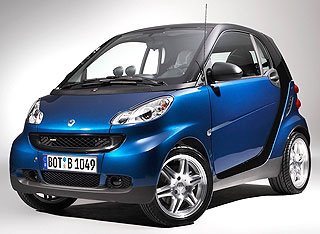
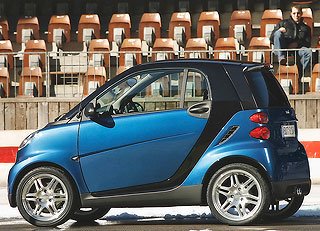
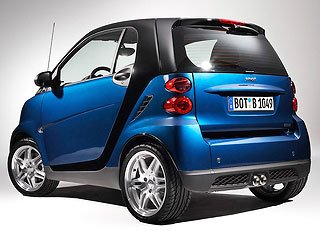
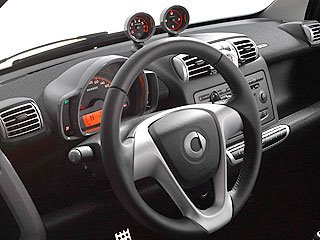
2008 Brabus smart fortwo

(from Brabus Press Release) The smart fortwo BRABUS: Powerful and agile

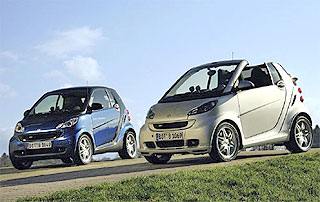
2008 Brabus smart fortwo2008 Brabus smart fortwo 22008 Brabus smart fortwo 32008 Brabus smart fortwo 42008 Brabus smart fortwo 5What started in 2002 as a joint venture between smart and BRABUS has developed over the years into extremely successful cooperation in the field of vehicle tuning. The great popularity of the BRABUS variants of the smart shows the increasing customer interest in individualised cars. Together with BRABUS, smart will continue to round off its model range with even more exclusive models. BRABUS variants boast both exclusive equipment and greater engine power.

The smart fortwo BRABUS places the primary focus on sportiness. Its three-cylinder one litre petrol engine delivers 72 kW (98 bhp) and develops maximum torque of 140 Newton metres. The transmission has also been configured for this. The first and the fifth gears have different transmission ratios to the pure, pulse and passion and – given the light weight of just 780 kilos – this lends the two-seater remarkably lively agility and enables a maximum speed of 155 km/h (limited). The car sprints from zero to 100 km/h in less than ten seconds.

The exterior of the fortwo BRABUS is first and foremost characterised by sporty "Monoblock VI" alloy wheels. These have 5.5 inch rims with 175/50 R 16 tyres at the front and 7.5 inch rims with 225/35 R 17 tyres at the rear together with external-mounted fender flares in the colour of the body. Furthermore, the fortwo BRABUS boasts a sports exhaust with a specially grained rear apron and fog lamps.

Special BRABUS logos and lettering embellish the body in the following places: a logo in the right and left mirror triangles and on the front grille, and BRABUS lettering on the rear. The fuel filler flap features an embossed BRABUS double B symbol in chrome. Further features include a panoramic roof made of polycarbonate, electric windows, air conditioning with temperature control and the "softouch" automatic gear programme.

A smart fortwo BRABUS wouldn't be a BRABUS if the tuning specialist from Bottrop hadn't also turned its attention to the suspension. This consists of four sports shock absorbers and four coil springs with a BRABUS-specific characteristic. The suspension lowers the fortwo BRABUS by 10 millimetres and also provides for more agile and direct handling.

The interior is distinguished from that of normal fortwo models by a number of BRABUS styling features. These include a BRABUS metal gear knob, a polished metal hand-brake handle and sports pedals. The speedometer, rev counter and clock also bear the BRABUS signature and the gauges, colour and styling of the numbers and pointers are all designed by BRABUS.

The same range of exterior colours is available for the smart fortwo BRABUS as for other smart fortwo models. Both the coupe and the cabrio are available as BRABUS versions.

Friday, February 23, 2007

Brabus Smart Fortwo

GENEVA — Mercedes tuning specialist Brabus, as part of its annual Geneva auto show display, will unveil two new performance variants of the recently redesigned Smart Fortwo.

Brabus Smart FortwoThe 1.0-liter three-cylinder gas engine in the Fortwo Brabus and Fortwo Brabus Xclusive gets a 30 percent boost in output to 98 horsepower, which enables 0-60-mph acceleration in less than 10 seconds. Top speed is electronically limited to 96 mph.

Brabus also has firmed up and lowered the suspension system to give the Fortwo a sportier ride with better handling. Monoblock VI alloy wheels and a sport exhaust system have been fitted. Other exterior modifications include foglamps and wider rear wheel arches. In addition, the Xclusive edition gets a front spoiler, rear apron, side skirts and tinted-glass headlamps.

The cabin receives a Brabus gearshift knob, handbrake handle and pedals, as well as signature tach, speedo and clock. The Xclusive boasts even more gear, including a leather-wrapped steering wheel, heated leather seats and Brabus floor mats.

Brabus says the Fortwo variants will reach European dealers this fall.

Thursday, February 15, 2007

The new smart fortwo: more power and more driving fun


State-of-the-art compact three-cylinder engines are installed at the rear of the new Smart fortwo. The all-aluminium engines were developed in cooperation with Mitsubishi, and are produced in Japan. They have been optimised for use in the new Smart fortwo.

Naturally aspirated petrol engines rated at 45 kW (61 bhp) or 52 kW (71 bhp) are available, as is a turbo engine delivering 62 kW (84 bhp). They all have capacity of 1.0 litres. In addition to the increase in power, the maximum speed has also been increased – to 145 km/h (electronically limited).

The engine is mounted transversally in front of the rear axle, and is slanted at an angle of 45
degrees towards the rear. The cylinder barrels take the form of grey cast iron liners. Gas exchange is controlled by four valves per combustion chamber. The valves are controlled by separate intake and exhaust camshafts, via bucket tappets. The camshafts are driven via a maintenance-free timing chain.

The engine reacts spontaneously to accelerator pedal movement even at low revs and demonstrates how effectively the three-cylinder engine's variable valve control works. The intake camshafts are twisted electrohydraulically against the exhaust camshafts, providing for better filling of the combustion chambers at low revs. This gives the Smart noticeably greater agility, especially in city traffic.

The 52 kW (71 bhp) version accelerates from 0 to 100 km/h in 13.3 seconds, giving it a head start against some other cars at the traffic lights. And that's no surprise – after all, a Smart fortwo weighs in at just 750 kilograms. The 62 kW (84 bhp) turbo version is even more dynamic sprinting from 0 to 100 km/h in 10.9 seconds.

The three-cylinder engine develops its typical beefy sound without being rough or loud. Because the masses being moved are low, there is no need for a balancer shaft – which would reduce the output of the engine. The turbo version has a torsional vibration damper on the crankshaft.

To ensure a long service life, the turbocharger is fitted with a water cooling system, while the charge air cooler is based on air/air technology and is located behind the transmission. The maximum charge pressure is 0.5 bar, with control taking place via a wastegate valve in the turbocharger. The naturally aspirated engine's compression ratio is 11.5:1, while in the turbo engine it is 10:1.

smart fortwo cdi: there's no more economical way of running a car

The modifications to the diesel engine have led to a ten percent power increase, which means that the engine now delivers 33 kW (45 bhp), but also consumes less than before. The new Smart fortwo cdi achieves the coveted "three-litre car" status.

The Smart fortwo cdi emits just 90 grams of CO2 per kilometre, corresponding to standard consumption of just 3.4 litres. At present there is no more economical car than the Smart fortwo cdi.

New transmission improves shifting comfort, consumption and agility

In future, Smart fortwo drivers will benefit from a newly-developed transmission that will take no time to get used to. Instead of the previous six gears, the transmission produced by the specialist Getrag now has five gears, and offers considerable advantages in terms of comfort, fuel consumption and agility.

In the new Smart fortwo there is once again no clutch pedal, as this task is performed by an electric motor. If the shift lever on the centre console is briefly tapped forwards, the transmission will shift up a gear, and if it is drawn back, down a gear. Alternatively, the gears can be changed by means of paddles on the steering wheel (standard for pulse).

To the right of the manual level, marked with a plus and minus sign, is the neutral position, N. Reverse gear is engaged by pulling the shift lever backwards from this position.

The Smart fortwo passion comes with the automatic gear programme (softouch) as standard (optional for pure and pulse). It can be recognised by a small button on the shift lever.

When this is pressed down, the transmission switches over from manual gear shifting (softip) to the automatic gear programme. It’s the ideal solution for use in stop-and-go traffic. As soon as the driver moves the shift lever manually, the system returns to manual gear-changing mode.

The developers have also greatly improved the shift delays. Shift delays have been reduced by more than half compared to the previous model. This is particularly beneficial when the driver wants to shift down two gears at once. This, coupled with the considerably increased torque, makes for even greater ride comfort. To improve ride comfort even more, the transmission has a kickdown function.

This allows the driver to use the accelerator pedal to shift down two gears at once, in both manual and automatic mode. Incorrect gear changing and overrevving are impossible, because the electronics will only accept logical gear changes.

Driving dynamics

Thanks to extensive changes to its suspension, and its new geometry, the smart’s handling has been significantly improved. It is now considerably more agile and responsive than its predecessor. However, despite the car’s more sporty design, no compromises are made on comfort, and longer journeys present no problem at all for the new Smart fortwo.

The wheelbase has increased by 55, the front track widths by seven, and the rear track widths by 31 millimetres. This reduces pitching and rolling movements. The anti-roll bar at the front is now directly hinged to the McPherson strut instead of the wishbone for better responsiveness.

The diameter of the anti-roll bar is 18.5 millimetres, and it very effectively prevents the vehicle body from rolling in bends. Tyres measuring 155/60 R 15 at the front are fitted at the factory on 4.5 inch steel rims. The passion boasts alloy wheels in the same size. The pulse equipment line comes with alloy wheels measuring 175/55 R 15.

The tried-and-tested DeDion construction has been kept at the rear. The position of the central mount has been changed (moved higher), which has had a positive effect on the manoeuvrability of the fortwo. The springs are now further out than in the previous model, thereby supporting the vehicle body even more effectively against rolling. The size of the tyres on the rear axle in the basic version is 175/55 R 15 on 5.5-inch rims. For the pulse the dimensions are 195/50 R 15.

The steering greatly influences the agile driving feel: the transmission ratio is 22:1. This means that the steering is transmitted almost ten percent more directly than that of the predecessor. The turning circle is just 8.75 metres – a figure unmatched by any other small car. This makes manoeuvring extremely easy.

It allows turning in places where any other car would have to shunt to and fro. And it’s just 3.5 turns of the wheel from stop to stop. Electric power steering is available for the Smart fortwo at an extra charge.

The transmission ratio is just 21:1. It operates on a linear basis and gives the fortwo astonishingly agile handling. The electric boost power varies according to vehicle speed, steering angle and the amount of force applied to the steering wheel.

All these measures mean that the Smart is now even sprightlier than before. It is noticeably agiler, sportier – and at the same time more comfortable.

esp is a standard feature

The electronic stability programme esp with integrated abs and electronic brake-force distribution are included in the standard spec, as is a hydraulic brake booster. Whereas other manufacturers in the micro car segment only offer esp subject to an additional charge – if at all – esp is a standard feature in the Smart fortwo.

The fortwo is the only car in its class to come with brake assist. When it detects abrupt emergency braking, brake assist automatically provides full brake pressure in order to ensure optimum deceleration. It offers a helping hand in those situations where the driver has pressed the brake pedal quickly, but not firmly enough.

Because the electronically limited maximum speed of the petrol engines has been increased, the Smart fortwo’s brakes have grown as well. Disc brakes are fitted at the front, while drum brakes are fitted at the rear.

Thursday, February 1, 2007

First Drive: Smart ForTwo CDi Passion


Small shoulders. Big responsibility... There’s no doubt that the pressure is on for Smart’s ForTwo. A few years ago, the firm’s city car range included a roadster and a four-door supermini. These days, only one model carries the troubled company’s hopes.

So, can the latest ForTwo save Smart? Totally fresh from the ground up, with more space, an increased emphasis on quality and a diesel engine for the first time, it’s better equipped than ever.

On initial viewing, the ForTwo has clearly lost a little of its visual charm. Nearly 20cm have been added to the length and 9cm to the width in the pursuit of better pedestrian safety and rear-impact protection – as well as more legroom. As a result, it’s not quite as cheekily compact as before.

Mind you, with bigger lights and chunkier bumpers at both front and rear, the car does look a bit tougher. And, thanks to plastic body panels, it’s still as distinctive and resistant to parking dings as ever.

Inside, the trademark twin, movable, pod-style dials continue to take pride of place on top of the dashboard, and there is a trendy mix of fabric and body-coloured trim. However, the big change is in quality. All the plastics feel of a higher grade, while the seats in particular are much more supportive. The increased dimensions have also resulted in more leg and shoulder room.

There’s additional boot space, too – up 70 litres to 220 litres. And as the ForTwo is being sold in the US from 2008, safety levels have been improved, with new head and side airbags as standard as well as more robust seats. A four-star Euro NCAP crash test rating is also expected.

As for equipment, the Pure model is very basically specified, coming only with central locking and a radio. Its Pulse and Passion stablemates both feature a panoramic roof and alloy wheels. Air-conditioning is standard only on the range-topping Passion. On the options list is portable satellite navigation and an MP3-compatible CD changer. Under the bonnet, there have been some significant alterations to the engine line-up. A new 1.0-litre three-cylinder petrol motor, developed with Mitsubishi, comes in three forms: a base 61bhp unit, a more punchy 71bhp version and the range-topping 84bhp turbo.

However, it’s the eagerly awaited CDI diesel that is the pick of the bunch. Developed by Mercedes, the three-cylinder unit features common-rail direct injection and pumps out a healthy 45bhp. Together, these give the little Smart a real turn of speed.

Factor in 80mpg economy, 90g/km emissions plus decent refinement, and it is clearly the star engine. It’s a pity this has yet to be confirmed for the UK. Still, helping the cause is another innovation – a new five-speed semi-auto gearbox. Much less jerky than the previous transmission, it makes for smoother progress in both fully automatic and manual modes.

Indeed, the whole driving experience has grown up. Thanks to the car’s increased wheelbase and wider track, the ForTwo seems more comfortable and stable than ever before. And while the old model could seem out of its depth when travelling on motorways, the newcomer feels much more secure at high speed.

Crucially, it has lost none of its manoeuvrability and boasts the same agility around town. It’s a shame the steering is as low-geared as before and doesn’t provide much feedback, but the ForTwo remains fun to drive.

Those looking for an even more involving experience will be keen on the forthcoming Cabriolet. It has a new fully automatic electric hood that can be raised or lowered to any position.

Prices will stay broadly in line with the current car’s, meaning the CoupĂ© kicks off at around £7,000 in 61bhp Pure form. Given the leaps made, that represents as good value as ever.

By Joachim Staat
www.autoexpress.co.uk