Showing posts with label Opel. Show all posts

Sunday, December 16, 2007

New Opel Agila: Mini Monocab Starts from 9,990 Euros

New Opel Agila: Mini Monocab Starts from 9,990 EurosFeaturing high practicality at an affordable price, the new Agila can now be ordered from 9,990 euros and will be available at dealerships from spring 2008. The new Opel Mini monocab offers plenty of feel-good space for family and friends, as well as up to 1050 liters of cargo capacity despite the car’s compact exterior length of 3.74 meters.

The new Agila is the youngest member of the highly successful Opel monocab family.

A monocab is distinguishable by its hood line that flows without a visible break into the combined passenger and luggage compartment. Thanks to this design and clever innovative details, the fully fledged five-door, five-seat Mini monocab can set standards in space economy and variability – just like the small Meriva and compact Zafira monocab have already done. The Meriva has been the top-selling small monocab in Europe since its launch in 2003, and leads the overall monocab segment together with the Zafira.

The new Agila is not only very affordable, but also boasts low fuel consumption and emissions: the Agila 1.0 with 48 kW/65 hp requires an average of five liters of gasoline per 100 km, while the 1.3 CDTI with 55 kW/75 hp and diesel particulate filter as standard consumes just 4.5 liters of diesel per 100 km. Both variants produce just 120 g CO2/km.

The entry-level Agila comes with a wide range of standard safety equipment. For less than 10,000 euros, customers get ABS, front and side airbags for both front passengers and ISOFIX child Seat mountings. Also on board ex works is speed-dependant power steering, height-adjustable front seats, rear window wiper with interval control and power tailgate with touchpad. Customers who order the new Agila ahead of its official market launch in early April 2008 will receive a Styling package from Opel as a bonus with their new car.

Friday, December 14, 2007

2008 Opel Agila Mini Monocab Starts from 9,990 Euros

Featuring high practicality at an affordable price, the new Opel Agila can now be ordered from 9,990 euros and will be available at dealerships from spring 2008. The new Opel mini monocab offers plenty of feel-good space for family and friends, as well as up to 1050 liters of cargo capacity despite the car’s compact exterior length of 3.74 meters.

2008 Opel Agila: © GM Corp.

2008 Opel Agila: © GM Corp.

The new Opel Agila is the youngest member of the highly successful Opel monocab family. A monocab is distinguishable by its hood line that flows without a visible break into the combined passenger and luggage compartment. Thanks to this design and clever innovative details, the fully fledged five-door, five-seat mini monocab can set standards in space economy and variability – just like the small Opel Meriva and compact Opel Zafira monocab have already done. The Meriva has been the top-selling small monocab in Europe since its launch in 2003, and leads the overall monocab segment together with the Opel Zafira.

The new Opel Agila is not only very affordable, but also boasts low fuel consumption and emissions: the Agila 1.0 with 48 kW/65 hp requires an average of five liters of gasoline per 100 km, while the 1.3 CDTI with 55 kW/75 hp and diesel particulate filter as standard consumes just 4.5 liters of diesel per 100 km. Both variants produce just 120 g CO2/km.

The entry-level Agila comes with a wide range of standard safety equipment. For less than 10,000 euros, customers get ABS, front and side airbags for both front passengers and ISOFIX child seat mountings. Also on board ex works is speed-dependant power steering, height-adjustable front seats, rear window wiper with interval control and power tailgate with touchpad. Customers who order the new Agila ahead of its official market launch in early April 2008 will receive a Styling package from Opel as a bonus with their new car.

Tuesday, December 11, 2007

Fresh Drive for Opel Monocab Range

Opel’s model range at the Bologna Motor Show (December 7 – 16, 2007) features no less than 17 seats and up to 4280 liters of load volume capacity. This is no illusion, but rather the combined characteristics of Opel’s three quick-change artists.

The automaker from Rüsselsheim highlights its monocab designs – body models where the hood and trunk are not visibly separate from the cabin – which enable plenty of interior flexibility. Opel consistently sends a clear signal with these models’ market success and innovative ideas.

Opel monocab range

Opel monocab range

The top attraction in Bologna is the world premiere of the new Zafira. The benchmark for fully variable seven-seaters in the compact monocab class, the new Zafira boasts fresh design accents and three additional engines with improved fuel economy. From February 2008, the European record of two million units sold since 1999 will be within reach.

Opel’s new monocab highlights continue with the Italian premiere of the brand-new Agila. The flexible five-seater with up to 1050 liters of load space and exterior length of just 3.74 meters establishes Opel in the mini monocab segment.

Completing the monocab trio is the spacious Meriva, which has been the top seller in the small monocab class in Europe since its market launch in 2003. A total of around 280,000 Meriva (120,000) and Europe’s top-selling seven-seater Zafira (160,000) models were sold from January through November 2007. The launch of the new Agila in spring 2008 will put Opel in an even better position to defend its top market position in the coming years.

Alain Visser, Chief Marketing Officer GM Europe, praised the monocab trio as ideal brand ambassadors: “Opel stands for maximum variability in affordable cars, and we realize this democratization of intelligent vehicle concepts right across our model classes. The new Agila continues the outstanding flexibility of the Zafira and Meriva models, whose extraordinary qualities have helped shape Opel’s brand profile.”

Opel’s principle of optimal use of space

Opel’s strategy for success with its monocab range is to offer as much space and practicality as possible within the most compact dimensions conceivable, and to adapt this concept to various model size classes. The patented Flex7 seating system in the 4.47-meter long Zafira is considered the benchmark among technological solutions for maximum interior variability. Europe’s top-selling seven-seater can easily be transformed into a two-seater with a cargo capacity of up to 1820 liters without cumbersome removal of the seats. With the FlexSpace concept, the Meriva brings an iteration of this successful innovation to the small monocab segment. The 4.05-meter long quick-change artist can be configured in every conceivable way – as a five, four, three, two or one-seater with 2.40-meter load-floor length and cargo capacity of 1410 liters. The new 3.74-meter long Agila echoes this flexibility and brilliant simplicity. Folding the 60:40-split rear bench seat back down creates a flat load floor and boosts the luggage compartment volume from 225 to 1050 liters - a capacity unrivalled by the Agila’s competitors.

Besides the efficient use of space, other monocab success factors include the high seating position for good visibility and the ease of entry and exit. Currently 13 percent of new passenger car registrations in Europe are for vehicles in this category. Frank Leopold, Manager Innovation, Advanced Package & Concept Cars, Adam Opel GmbH, sees a bright future for monocabs: “In the past, cars were just made longer and wider to create more space. But Flex7, which is incorporated in the monocab design, presented an alternative. And as just making cars bigger is also not very environmentally friendly, the trend toward efficient innovations à la Opel will continue.”

Intelligent space concept reduces per-head consumption

The intelligent design concept of providing maximum variability and plenty of space despite compact dimensions and less weight are key to the Opel monocabs’ environmental compatibility and economy. The new mini monocab is the latest proof of this, as the Agila 1.0 and 1.3 CDTI require just 5.0 and 4.5 liters of fuel respectively per 100 kilometers. The corresponding CO2 value of 120 g/km means when fully occupied, the Agila emits an extremely environmentally friendly 24 g CO2/km and seat. The Zafira 1.6 CNG (Compressed Natural Gas) has an even more impressive emission value: its five-kilogram consumption of H-gas per 100 km results in just 138 g CO2/km. With six passengers plus driver, the Zafira 1.6 CNG – available as an Opel ecoFLEX model from spring 2008 – produces just 20 g CO2/km and seat.

The addition of the new 1.6-liter gasoline engine (85 kW/115 hp) and two 1.7 CDTI common-rail turbo-diesels (81 kW/110 hp and 92 kW/125 hp) expands the Zafira engine range with more economical units that provide greater output but consume less fuel. Aside from the CNG unit, there is a total of five gasoline and four diesel engines with displacements from 1.6 to 2.2 liters and an output range of 85 to 177 kW (115 to 240 hp). The Meriva also boasts a broad engine range, with four gasoline and three common-rail turbo-diesel ECOTEC units. Their displacements range from 1.3 to 1.8 liters, with outputs from 55 to 132 kW (75 to 180 hp). The models that attract the greatest attention, however, are the turbo-charged top-of-the line Zafira and Meriva OPCs. Buyers enjoy maximum flexibility combined with maximum performance, as the Zafira and Meriva OPC models come with Flex7 or FlexSpace coupled with a top speed of 231 or 222 km/h respectively.

Unique technology features

The Zafira is not just monocab pioneer in interior flexibility, but also in technology. The IDSPlus (Interactive Driving System) with electronic Continuous Dampening Control (CDC) is unique in this segment, and the Trailer Stability Assist (TSA) sets standards, providing a significant boost in safety for car-trailer drivers. While the bi-xenon AFL (Adaptive Forward Lighting) headlamps with dynamic curve light ensure considerably improved road illumination, the panorama roof system offers two benefits for Zafira passengers: it provides a pleasant feeling of spaciousness on board, and helps keep the interior tidy thanks to the roof console running the entire length of the cabin.

“Our monocab range, with its high levels of flexibility, state-of-the-art technology at affordable prices and innovative ideas, is rounded off perfectly by the new Agila. This new model will further strengthen our leading position in this segment,” says Alain Visser.

2008 Koenigseder Opel GT'Aime

Desire for an affair?
Kцnigseder makes his own motor show - not in Essen - but with his work on Opel GT. Women finally know what they want: 300 sleek-tuned PS.

The affair Koenigseder and Opel takes place.
With aerodynamic accents - frontspoiler and rear wing - race wins over mass and causes exactly the tension which an affair consists of. They emphasize the soft silhouette on the one hand and power the dynamic character of the car on the other hand.

2008 Koenigseder Opel GT2008 Koenigseder Opel GT-22008 Koenigseder Opel GT-32008 Koenigseder Opel GT-4A KW coilover suspension version 3 guarantees sporty driving and lap records through individual damper adjustmest - also due to the Yokohama tires.

Las Vegas: 20" Giovanna Dalar rims remind of Elvis' best times with rivet belts and match the car like chalk and cheese. Two American giants meet at Konigseder. Why not earlier?

The custom made Brembo brake system provides excellent deceleration and the 332mm brake discs with red 4 pistons calipers underline the exciting erotic style of this convertible.

The climax of the affair - naturally - takes place in the interior:
Very special: Hand made wooden car floor in black and red with GT`aime writing.

Tuesday, July 17, 2007

2007 Opel GT with KW Coilover Suspension V3

Sportier appearance and better handling: KW coilover suspension V3 for Opel GT

2007 Opel GT with KW Coilover Suspension V32007 Opel GT with KW Coilover Suspension V3 2* Racing-technology for the road
* Customised lowering of suspension up to 45 mm
* Coilover suspensions produced in stainless steel "inox-line" technology

"Only flying is more beautiful" was the old commercial slogan in the late 1960s, when the first Opel GT was presented to the public. In terms of driving dynamics there are worlds between the new generation of the Opel GT and its predecessor. And there are even more between them, if you use a KW coilover suspension V3. With it one can lower the car in a range from 20 to 40 mm at the front axle and from 20 to 45 mm at the rear. The KW coilover suspension V3 for the Opel GT is available with immediate effect.

KW coilover suspensions - 3 damping variants for every type of driver

Coilover suspension V1 with preset damper setting permits customised lowering of the suspension and creates an optimised balance of sportiness, comfort and safety. Damping variant V2 is the ideal system for sporty drivers, who also wish to make modifications in the set-up to achieve a more customised lowering of the suspension. Thanks to the adjustable rebound damping, it is possible to adapt the driving comfort to suit the driver's personal taste.
With its separately adjustable pressure and rebound damping functions, coilover suspension V3 permits an even higher degree of customisation to the suspension and provides the perfect solution for those truly technically demanding drivers.

All KW coilover suspensions are produced in the unique stainless steel "inox line" technology. This assures the extremely high quality and durability of the suspensions plus a long-lasting perfect finish to match.

Wednesday, July 11, 2007

New Opel Agila: Friendly, dynamic, flexible

New Opel Agila: Friendly, dynamic, flexibleWith five doors and five seats, the new Opel Agila is not only as practical as its predecessor, which sold over 440,000 units, but is now also much more dynamically designed. The small, versatile Opel will be unveiled to the public at the IAA in Frankfurt (September 13 – 23, 2007) and makes its market premiere in spring 2008. It boasts balanced proportions, soft curves and a distinctive side graphic.

Its passengers still sit high and upright, but the roofline has been dynamically lowered and now blends into a smooth arc toward the rear. This helps create the Agila’s aerodynamic drag
coefficient of 0.35 – a relatively low figure for a vehicle of this size. The urban car is now 20 centimeters longer, six centimeters wider, but seven centimeters lower than its predecessor.

The front boasts typical Opel styling. With its round headlamps integrated into almond-shaped lamp units that echo the new Corsa, the Agila sees the world through wide eyes. The tapering of the front and rear bumpers are also typical Opel elements, just like the crease in the hood. The rear also features several rounded details. The positioning of the narrow vertical light units, which are accented by the spherically styled rear lights, allowed designers to create a large, easy load-through tailgate.

The same is true for the interior: the boring days are over. A wide selection of fresh colors and modern styles create an ambience that’s enhanced even more by the spacious headroom. The versatile five-seater’s high seating position ensures good visibility, while the high placed gear stick and height-adjustable steering wheel with radio remote controls ensure easy operation. The rev counter is housed separately on the instrument panel. All other information readouts are given on large, distinctive, round instruments.

As an urban car it also offers plenty of compartments and boxes for storing all passengers’ belongings. But it’s not just car essentials that the new Agila stows away easily. Despite its compact exterior dimensions, the new Opel urban car boasts a surprisingly large luggage compartment. Its standard capacity up to the luggage compartment cover is 225 liters, large enough for a stroller, for example. One turn of a handle drops the rear bench Seat back, increasing the load volume to an impressive 1050 liters – a top value in this segment. The rear bench Seat and back also splits 60:40 for even greater versatility.

All Agila models have a wide range of standard equipment, including safety features such as ABS, front and side airbags for driver and front passenger, front passenger airbag deactivation and mountings for the ISOFIX child Seat system. And thanks to the five doors as standard, small children can be secured into a child Seat quickly and safely. Standard comfort features in the entry-level version include speed-dependent power steering, height-adjustable driver and front passenger seats, rear window washer with interval selection and power tailgate with touchpad. The Enjoy model boasts an even greater range of standard features.

Two gasoline engines make their world premiere in the new Agila. Supplied by cooperation partner Suzuki, they share the same design - aluminum cylinder block and head, as well as two overhead camshafts.

The entry-level unit is the almost one-liter, three-cylinder gasoline engine. The four-valve unit produces 65 hp (48 kW) and has a top speed of 160 km/h1. The 1.2-liter four-cylinder gasoline engine produces 86 hp (63 kW), accelerates from zero to 100 km/h in less than 12 seconds and has a top speed of 174 km/h (values for five-speed manual version). This engine is now optionally available with a four-speed automatic transmission – an especially attractive alternative for city driving.

The fuel-saving master among the Agila engines is the 1.3-liter common-rail turbo-diesel. Developed by GM Powertrain, the diesel engine is a true multi-talent and also offers an especially efficient alternative in the Corsa and Astra model lines. In the new Agila it produces 75 hp (55 kW), has a top speed of 162 km/h and a zero to 100 km/h sprint of 13.5 seconds. The powerful diesel unit with a maximum torque of 190 Nm is very economical: on average it consumes less than five liters per 100 km, which represents a CO2 per kilometer value of under 130 g (finalized values not yet available).

Make the Agila even more agile – that was the aim during chassis development. The new dynamic look is also reflected in the car’s responsiveness. The Agila’s chassis, which features A-arms and McPherson struts in front and a torsion beam axle in the rear, is tuned for driving fun. Depending on the market and equipment variant, the Agila also features an Electronic Stability Program (ESP).

Monday, May 14, 2007

Opel’s new Agila ready to hit the road

52873vau.jpg

The theme with carmakers across Europe seams to be ‘going small’, with the minicar segment seriously heating up with new entrants due from most of the major labels. Pictured here is the new Opel/Vauxhall Agila five door hatch that’s due to hit showrooms by spring next year. Its versatile design allows users to fold down the back seats to accommodate a class-leading 1150L of storage space.

The next-gen Agila will offer three new engines and an automatic gearbox option will be available for the first time but only for 1.2L versions. The most popular will be the two petrol units, a 1.0L three-cylinder with 65hp and a 1.2L four-cylinder with 86hp. Diesel fans will get an updated 1.3L CDTi, as seen in the Corsa, with 75hp on tap.

The vehicle’s safety package comprises of comprising four airbags as well as an optional Electronic Stability Program. New Agila will make its debut at the Frankfurt motor show in September with final pricing expected to be announced closer to the vehicle’s launch in the first half of next year.

52873_b_vau.jpg52873_a_vau.jpg

Via motorauthority.com

Tuesday, March 27, 2007

Opel Tigra TwinTop Now Wears Mango Fashion

Opel and the Spanish fashion brand Mango have signed an agreement to launch a joint advertising campaign across Europe from this spring. The cooperation between the two firms promotes the two-seat Tigra TwinTop cabrio and the current Mango collection. “Every street is a catwalk, and that goes for people and their clothes as well as for cars,” says Olivier Danan, Director Marketing Communication for Opel, explaining the concept behind the cooperation. “Today more than ever before, cars are also considered chic accessories that have to fit an overall stylish look.”

Ever since its launch two and a half years ago, the Opel Tigra TwinTop has been mainly aimed towards stylish, trend-conscience young women. “Our target groups are the same as Mango’s, so it made good sense to jointly promote our products’ attractiveness,” said Olivier Danan.

The campaign includes different actions in each market, like contests, catwalk during a motor show with special ladies day, special day shopping in Paris or a sweepstake to win a shopping voucher.

For the advertising initiative, Opel will use models dressed in Mango fashions to promote the Tigra TwinTop both on the Internet, in newspapers and magazines. Other country-specific opportunities in Europe are also being explored.

The sporty two-seater with electro-hydraulic retractable steel roof is available in Germany from 17,983 euros. Buyers who wish to combine open-air driving in the Opel Tigra TwinTop with very low CO2 emissions can choose the 1.3 CDTI ECOTEC engine, which emits just 124 g/km.

Tuesday, March 20, 2007

Opel Reveals Details on Performance-Oriented Corsa OPC

RUSSELSHEIM, Germany — The latest member of Opel's OPC lineup is the new Corsa OPC, a valiant little performer that is equipped with a 192-horsepower turbocharged engine and Recaro seats. Opel brass said they will begin to roll out the new Corsa model throughout Europe this month and noted that "Growth markets like Russia will also play a role." There are no plans to bring the compact three-door to the U.S., however.

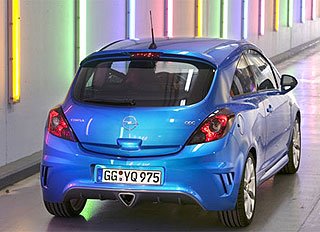
Opel Corsa OPCOpel Corsa OPC 2Opel Corsa OPC 3The Corsa OPC goes from zero to 62 mph in 7.2 seconds and has a top speed of 140 mph. Maximum torque is pegged at 170 pound-feet, and the four-cylinder engine is linked to a standard six-speed transmission.

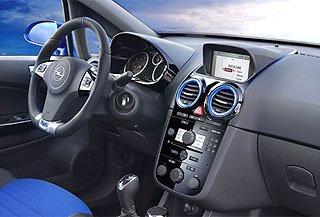
Exterior design cues include a roof spoiler, front and rear aprons with gills, and a triangular tailpipe. Cabin touches include a flat-bottomed leather sport steering wheel, aluminum pedals and piano black trim. The sport seats are a new joint development by Opel and Recaro. The Corsa OPC also gets 17-inch alloy wheels and variable-progressive steering. The chassis has been lowered by 0.6 inch compared with that of the base Corsa.

Tuesday, March 6, 2007

Opel Reveals Striking Opel GTC Concept Car in Geneva

Opel GTC Concept
Opel GTC Concept -- Gran Turismo Coupé (European Pressphoto Agency)

On the eve of the 77th Geneva Motor Show, Opel illuminated the night. Supported by a dramatic light show, the Opel GTC Concept (Gran Turismo Coupé) made its spectacular debut at the "GM Premiere Night."

Heralding a new design era for the brand, the Opel GTC Concept gives an insight into how Opel's design language will look in the future. Adding to progressive shapes and surfaces, the four-seat coupé features unique LED lighting concepts in the front and rear, providing a new signature lighting style for the brand.

The reveal's exciting light show highlighted the Opel GTC Concept's signature illumination theme by utilizing state-of-the-art LED technology for the huge stage wall. The car then strutted down a long runway to its final resting spot on a turntable in the center of the room.

Visual effects of the evening were also part of the futuristic iBar concept: Items like mobile phones or drink glasses rested on the bar tops were connected by animation of the concept car and the Opel emblem. In addition, a common denominator of the show was the color red, reflecting the interior lighting theme of the concept car and the red line in its seats, steering wheel and tires.

Two live performances of the U.S. band "Pink Martini" and a fashion show of the hip Spanish label "Mango" rounded off the spectacular presentation of the Opel GTC Concept.

"This evening's presentation perfectly highlighted the Opel GTC Concept as the new interpretation of the Opel brand," explained Alain Visser, Executive Director, European Opel Marketing. "The concept car's exciting lines, high driving dynamics and interior flexibility reflect what the Opel brand trademark characteristics will be in the future."

"With the Opel GTC Concept our team envisioned the new essence of Opel - more confident, relevant and distinctive - in a high-performance four-seat coupé," said Bryan Nesbitt, Executive Director, GM Europe Design. "This style is what to expect of future Opel products."

Key elements of the Opel GTC Concept (length/width/height: 4830/1867/1432 millimeters, wheelbase: 2737 mm) begin with an aggressive front end performance face emphasized by large aluminum vertical intakes that intersect the headlamps. These vertical elements are mimicked in the rear exhaust elements. Another significant design cue of the two-door sport-coupé is the sophisticated bodyside shapes and surfacing.

Echoing the exterior, the interior visually articulates a dynamic driving experience and reveals a new standard of Opel aesthetics. Brand-typical on-board flexibility is ensured by the thoughtful "Flex4" system. The backs of both rear seats can be docked separately to the front seats by remote control, creating a spacious three or two-seater with flat load floor.

The Opel GTC Concept is powered by a 220 kW/300 hp, 2.8-liter V6 turbo gasoline engine and features an intelligent, electronically-controlled four-wheel drive system.

Source: Adam Opel GmbH

Thursday, February 15, 2007

2007 Opel Corsa Receives Top Eastern and Central European Automotive Award

  • Opel Managing Director Hans Demant Accepts AUTOBEST 2007 Award in Budapest
  • 115,000 New Opel Corsas Already Registered in Europe

2007 Opel Corsa
2007 Opel Corsa

RÜSSELSHEIM, Germany and BUDAPEST, February 15/PRNewswire/ -- After winning one of the most important European automotive awards, AUTOBEST 2007, the Opel Corsa was the star of the show yesterday in Budapest, with Opel Managing Director Hans Demant present to accept the trophy at the exclusive ceremony. The choice of AUTOBEST 2007 was decided by a jury of 13 leading automotive journalists from Eastern and Central Europe. The new model came first ahead of the Fiat Grande Punto and Peugeot 207. "We are especially pleased that the Corsa has also been so well received in these growth markets," said Hans Demant. And it is not just automotive experts who hold the bold and daring small car, which went on sale last October, in high esteem. With around 115,000 registrations throughout Europe by the end of January, European buyers have also shown their appreciation for the new Corsa, propelling it into third place in the overall car sales list for January 2007.

The new Corsa's reputation as "Everybody's darling" was confirmed over the last weeks with more than a dozen awards from all across Europe. In Denmark, the United Kingdom, Czech Republic, Romania, Serbia, Croatia and Slovenia, the Corsa was named "Car of the Year" by automotive journalists and other car experts. In Switzerland, Norway and Germany, it was awarded the title of "Best Small Car", as well as "Top Car 2007" by 140 German-speaking automotive journalists.

The jury took 13 criteria into consideration when selecting the AUTOBEST car winner. Each category is worth a specific number of points depending on its importance. With 60 out of a total of 240 points, value for money is the most important criterion. Other key issues, such as consumption, cargo capacity, distribution network, as well as service and spare parts availability are worth 20 points each. Design is worth a maximum of 30 points, and other criteria such as new technology, handling, dynamics and environmental compatibility are also considered.

The international AUTOBEST jury represents almost all the important growth markets in Europe. This year's AUTOBEST jury included members from 13 countries, covering a potential market of more than 250 million people. AUTOBEST is the second-largest independent motoring jury in Europe.


Source: Adam Opel GmbH

Wednesday, January 31, 2007

Opel Meriva: Shooting Star in TÜV Report 2007

  • Best in low defect rate category/Other Opel models climb in rankings in 2007
  • Opel Managing Director Demant: “Our quality initiative is clearly reaping rewards”
Opel Meriva
The Opel Meriva debuts in TÜV report as favorite among TÜV engineers. The Opel bestseller has by far the lowest defect rate.

The Opel Meriva has achieved the lowest defect rate in the TÜV report 2007. Introduced in 2003 and now tested for the first time (first general inspection is three years after initial registration), the minivan immediately established itself as the top performer in this quality check. 113 different models with ages up to three years are indexed. Faults were only found in 1.8 percent of the bestselling Opel Merivas that were checked; the industry average was 5.9 percent.

“Our comprehensive quality initiative is clearly paying off,” says Hans H. Demant, Opel Managing Director. “There is hardly a better indicator than this success achieved by one of our newest models. And the overall results for the Opel model range show that we are on the right track.” Compared to last year’s results, almost all of Opel’s models improved significantly in the TÜV report 2007, both in the rankings as well as the defect rate percentages. In addition to the Meriva, the Corsa (4.4 percent), Vectra (4.5 percent), Agila (4.8 percent) and Astra (5.1 percent) are all better positioned than the industry average. This puts all the models in the low defect rate category.

The Meriva’s victory is even more significant considering that a model rarely achieves a defect rate of less than two percent, and the next placed competitors scored well over this figure. The TÜV report 2007 records the results of all general inspections that were conducted according to §29 of the German Road Traffic Regulations (StVZO) by TÜV test centers from July 2005 through June 2006. It is based on the results of over seven million vehicle checks during the reporting period.

The significant progress shown in the TÜV report 2007 is the result of General Motors’ global quality initiative. The important aspects of GM’s integrated quality philosophy are standardized development (Global Vehicle Development Process) and manufacturing processes (Global Manufacturing System). Five principles are applied in all plants: People involvement, Standardization, Built-in-quality, Short lead time and Continuous improvement. Every employee on the production line, for example, is obliged to stop production if a problem occurs that absolutely cannot be resolved within the specified cycle time.

In light of suppliers’ growing role in the manufacturing of cars, supplier quality is becoming more and more important. General Motors Europe supports suppliers with a team of more than 100 specialist engineers that works solely on preventing or solving possible quality problems of partners at their source. And with notable success: the percentage of supplier components that failed to meet the quality norms sank in the last years by 80 percent.

“The spotlight on quality continues to intensify and expand. To only focus on production quality would not be enough,” says Peter G. Dersley, GME Vice President responsible for Quality. “It is very clear to us that we can only make significant progress in the various aspects of quality when we also completely satisfy our customers regarding what we call perceptual quality and the entire image of the car.”

source: Opel

Thursday, January 25, 2007

Opel Goes Roadster with the New Opel GT

  • Classic proportions: sleek silhouette, long hood, short overhangs
  • Archetypal roadster architecture with front-mounted engine and rear-wheel drive
  • High-tech turbo direct injection and twin A-arms
  • Roadster fun and performance at affordable price: 264 hp for 30,675 Euros

New Opel GT
New Opel GT

The modern definition of an athletic two-seater finds its form in the new Opel GT. As a classic roadster, it has a powerful front-mounted engine, rear-wheel drive, a cockpit with sporty instruments and a tailor-made fabric roof. With a wide stance, sleek silhouette, long, front-hinged hood and short overhangs, the proportions are typical of this class. The Opel GT also brings new charm to this genre with its own unmistakable personality thanks to its exciting shape, which contrasts sharp edges with curved surfaces to create a dynamic look, and its configuration, which enables a refined driving experience, even on long journeys.

The Opel GT’s pricing is also attractive. For 30,675 euros (recommended retail price in Germany incl. VAT), customers get no less than 264 hp from the high-tech turbo engine with gasoline direct injection. Acceleration from zero to 100 km/h takes less than six seconds. The new two-seater carries its legendary name because it continues the tradition of the first Opel GT (1968 – 1973) and, like the original, competes in one of the most exciting vehicle classes.

The new Opel GT also showcases the brand’s passion for dynamic cars, and the conviction that “Opel was never as young as today”. This is underlined by niche models with a high fun factor, such as the Astra GTC with panorama windshield, the Tigra TwinTop and Astra TwinTop cabrio-coupés, as well as the high-performance OPC family. They enrich the model portfolio and emotionalize the brand.

The development of the Opel GT is a prime example of transcontinental collaboration within GM. It stems from the decision to expand the concern’s portfolio with a compact, rear-wheel drive, sporty vehicle architecture that can be implemented globally. The first step towards realizing this idea was the Solstice concept car in 2002, followed a year later by the Vauxhall VX Lightning concept, which was conceived at the GM Advanced Design Studio in Coventry, England. Strongly inspired by the VX, the Opel GT has been adapted to the current Opel design language at the GM Design Studio in Detroit and the GM Europe Design Studios in Rüsselsheim under the direction of Bryan Nesbitt. The Opel roadster will be built at the Wilmington/Delaware plant in the USA, where its highly successful American GM sister models, the Pontiac Solstice and the Saturn Sky, are also produced.

New Opel GT
New Opel GT

The new GT’s story is reminiscent of that of its classic predecessor. In 1968, the original Opel GT set an automotive manufacturing precedent in Europe when it became the first car to go into production after being debuted to the public as a concept study. The legendary American sports car, the Corvette, made the same start in 1953 in the USA. The new Opel GT shares some engineering characteristics with the current Chevrolet Corvette, such as part of the architecture.

Crisp, dynamic look with strong face

Sharp lines coupled with taut surfaces give the new Opel GT a crisp, dynamic look. Its strong face is dominated by the fender’s accentuated sweep, the bold chrome crossbar with integrated Opel logo, the elongated hood with brand-typical center crease, chrome-bordered vents and bold 3-D headlamps in clear glass look drawn deep into the side panels. The GT’s especially sporty characteristics include the long air vents in the hood, the grooving in the front fenders with their dynamic, Opel-typical horizontal contours − like on the Antara −, the double-pipe exhaust system and the twin air scoops behind the head restraints, which are reminiscent of designs from roadster and motor sport history. 18-inch aluminum wheels in new five-spoke design fill out the wheelarches, and emphasize the roadster character, as does the fabric roof, which completely disappears beneath a cover for open-top driving fun.

New Opel GT
New Opel GT

Chrome-ringed instruments in the cockpit clearly display all important information, while black piano lacquer and chrome finishes accentuate the high-tech nuance of the surface structures. These all combine with optional leather seats with visible stitching to highlight the sporty ambience. The short gear stick adds significantly to the driving fun: directly connected straight to the roadster’s five-speed transmission, its short gear travel enables quick gear shifts from the roadster-typical seating position.

High-tech turbo engine with direct injection and variable camshaft phasing

The new Opel GT does not just look quick, it is quick! Its longitudinally front-installed 264 hp engine with turbocharging and gasoline direct injection accelerates the roadster to 100 km/h from a standing start in just 5.7 seconds, and up to a top speed of around 230 km/h. “When it comes to high-performance roadsters, there is no better balance between price, driving enjoyment and fun,” says Alain Visser, Executive Director Sales and Marketing, Opel. There’s no question about it: no other Opel has ever produced 132 hp output per liter. The new Opel GT’s engine not only complements the car’s dynamic look perfectly, it also far outperforms today’s other roadsters and most two-seat sports cars.

Opel GT, 2.0 Sidi Turbo
Opel GT, 2.0 Sidi Turbo Engine

High-tech features such as gasoline direct injection, twin-scroll turbocharger with intercooler, double camshaft phasing and twin counter-rotating balance shafts provide the basis for the 1998 cm3, four-cylinder engine’s impressive performance data. Maximum output of 194 kW/264 hp at 5300 rpm and high torque plateau of 353 Nm between 2500 and 5000 rpm ensure plenty of power in all situations. The GT requires an average of 9.2 liters of super unleaded gasoline per 100 kilometers. Jointly developed by GM Powertrain engineers on both sides of the Atlantic, the all-aluminum ECOTEC unit is based on the 2.2-liter direct injection unit available in the Vectra model range since 2004, and on the 2.0-liter turbo induction unit, which debuted in the Vectra GTS in spring 2003.

Chassis with classic sporty configuration

For the Opel GT, engineers designed a classic, sporty configuration based on a rigid chassis, wide track (front/rear: 1543/1561 mm) and long wheelbase of 2415 mm: all four wheels are suspended from twin A-arms made from forged aluminum, the center of gravity is low, and the weight distribution of 51:49 percent (front/rear) is well balanced.
A manual five-speed transmission with sporty, short gear travel and limited slip differential provide propulsion power. A torque beam between the transmission and rear axle suppresses reactions to acceleration/deceleration effects.

New Opel GT
New Opel GT

While disk brakes on all wheels, ABS, Traction Control (TC) and the Electronic Stability Program (ESP) monitor safety, the driver can control the level of ESP and use of TC himself. Both systems are fully active after ignition, with the setup providing driving fun but also keeping the vehicle stable within the physical limitations. At the touch of the ESP button in the instrument panel, the Traction Control (TC) is switched off, but ESP remains active and intervenes as soon as the yaw angle exceeds certain thresholds. Two short presses change the ESP’s calibration to a sportier mode and keep the Traction Control (TC) deactivated. Pushing and holding the ESP again for around ten seconds until the “ESP Off” symbol illuminates, completely deactivates ESP and TC. A short press of the button in any mode returns the two systems to their normal states, which also occurs automatically with each new engine start. A display and control light in the instrument panel keeps the driver informed about the current status of both systems.

New Opel GT
New Opel GT

Stiff vehicle structure with center tunnel and side members

The typical roadster vehicle architecture was designed from the beginning to meet the special demands of an open-top, two-seat sports car without compromise. The vehicle structure, which consists of hydroformed side members and a supporting center tunnel made from drawn sheet steel, provides a solid basis for the car’s precise handling and passive safety. The hydroforming forging technique, in which components are manufactured from steel with the help of high water pressure, is already employed in automobile construction for chassis components in the Opel Vectra and Opel Astra.

New Opel GT
New Opel GT

Only the legendary American Corvette sports car is also based on hydroformed side members. But the Opel GT also breaks new ground in another regard: the GT model family belongs to the first car line produced in significant numbers to have numerous exterior parts made using a procedure that is relatively time-consuming, but provides designers with greater creative freedom. The hood is one example: thanks to unconventional hydraulic technology − known as super forming − the long hood section with its front hinges was optimally integrated into the roadster’s silhouette without a gap between the hood and fender.

Extensive standard equipment

Extensive standard equipment in the Opel GT includes:

* 18-inch alloy wheels with 245/45 R 18 tires
* Anti-lock Braking System ABS
* Electronic Stability Program ESP (can be adjusted and switched off)
* Traction Control TC (can be switched off)
* Two-stage airbags for driver and passenger
* Occupant detection for passenger seat (with cockpit display)
* Three-point safety belts with pretensioners and belt-force limiters
* CD-Radio (six loudspeakers, steering wheel remote controls, MP3 player connection)
* Power exterior mirrors
* Power windows
* Power height-adjustable driver’s seat
* Cruise control
* Air conditioning
* Leather steering wheel and gearshift knob
* Manual soft top with heated rear glass window
* Fog lamps
* Remote control central locking, including remote trunk-lid release


The first Opel GTs will be on the road in March 2007 and dealerships have been accepting orders since summer 2006.

New Opel GT: Technical Data Overview:


Engine / transmission


Emissions standard compliance


Euro 4

Fuel


super unleaded

Number of cylinders


4

Bore

mm

86.0

Stroke

mm

86.0

Displacement

cm3

1998

Max. output

kW (hp)

194 (264)


at rpm

5300

Max. torque

Nm

353


at rpm

2500 - 5000

Transmission


5-speed, manual

Driving performance

Fuel consumption in l/100 km

Maximum speed
in km/h

Acceleration from
0 – 100 km/h in seconds


Urban


Extra-urban


Combined

CO2 emissions
in g/km

229

5.7

13.0

6.9

9.2

218

Car dimensions in mm


Length

4100

Width

1813

Height (at curb weight)

1274

Wheelbase

2415

Track, front

1543

Track, rear

1561

Turning clearance in m


Curb-to-curb

10.45

Luggage compartment capacity (liter)


Roof closed

157

Roof open

66

Weight and axle load in kg


Curb weight excl. driver (according to 70/156/EU)

1331

Gross vehicle weight

1625

Maximum axle load, front

850

Maximum axle load, rear

775


All data refer to the European base model with standard equipment. The consumption data according to 1999/100/EU takes into consideration the vehicle’s curb weight as stipulated by this regulation. The published performance figures are possible with the vehicle’s curb weight excluding driver plus a 200 kilogram load allowance.

Opinions on New Opel GT

Carl-Peter Forster,
President General Motors Europe:
“Develop and build cars with passion − nothing better defines what drives our team. And our customers will feel our passion when they start up the new Opel GT. With the new roadster, we now have an impressive and multifaceted large portfolio of niche products, including the Tigra and Astra TwinTops, which all offer open-top driving fun in their own unique way.”

Hans Demant,
Managing Director, Adam Opel GmbH and GME Vice President, Engineering:
“The new Opel GT is a prime example of the technology and design potential that our growing global cooperation within GM offers. We can develop products based on joint vehicle architectures, which not only boast brand-specific characteristics and are worthwhile in smaller production runs, but also enhance the Opel image.”

Bryan Nesbitt,
Executive Director Design, GM Europe:
“Designing a roadster is one of the treats of the profession. You know from day one it must exude emotion and fashion beyond all else. The Opel GT is more than a car, it suggests a lifestyle."

Alain Visser,
Executive Director, European Opel Marketing:
“An absolute dream car, and thanks to its attractive, affordable price starting from 30,675 euros, it’s a dream that can come true. The new Opel GT concept is in line with its legendary predecessor, and with a powerful turbo engine, the purebred roadster enjoys an exceptional place in its segment.”

Chris Pinn,
Chief Engineer, Model Line:
“In the development division, our enthusiasm for the new Opel GT knew no boundaries: we constantly had to keep an eye on the keys to the prototypes!”

Opel GT: New Icon in Roadster Scene

* With 264 turbo hp for 30,675 euros, new GT offers plenty of power for the money
* Ample fresh air and driving enjoyment means lots of roadster fun for two
* Legitimate heir to the ’68 cult coupé

With a wide stance, long, front-hinged hood, sleek silhouette, bold rear, cockpit for two and a tailor-made fabric roof, which completely disappears under a cover, the new athletic two-seat Opel GT storms into a segment that is charged by emotion more than any other. As a clear commitment to pure driving fun, the GT is a roadster that perfectly fits into the Opel model range, even if its goal is not top marks for luggage compartment space, flexibility or family suitability: the new two-seater continues a tradition first started by the Opel GT in 1968.
New Opel GT
New Opel GT


The new Opel GT also showcases the passion for building dynamic cars, and the conviction that “Opel was never as young as today”. This is underlined by niche models with a high fun factor, such as the Astra GTC with panorama windshield, the Tigra TwinTop and Astra TwinTop cabrio-coupés, as well as the high-performance OPC model family. They enrich the model portfolio and emotionalize the brand.

But the GT would not be a true Opel if it did not also appeal to customers’ more practical side. “When it comes to high-performance roadsters, there is no better balance between price, driving enjoyment and fun,” says Alain Visser, Executive Director Sales and Marketing, Opel. The new GT also follows in the footsteps of its predecessor when it comes to its 30,675 euro price tag. At 10,767 German marks, the first GT also caused a sensation with its price in 1968. At that time, this was equivalent to roughly 10 months’ average gross wages; around 490 euros a month today. Almost 40 years later, the price ratio for the new GT is now even somewhat improved. Today, the average wage has risen to 3500 euros, and while buyers no longer get a steel roof, they do get almost three times the power of the 90 hp GT 1900.

The legend lives on

The legend of an affordable sports car lives on. The new two-seater has the advantage of being designed on roadster architecture right from the start. The original GT from the 1960s was based on a pre-existing Opel sedan model. The reason for this was the limited production capacity at the time. In order to undertake assembly at the Bochum plant, the ’68 model had to be based on the Kadett. The bodies were produced in France, and the sale of one of the plants to a competitor in the automotive industry was a key reason for ceasing production in 1973. Up to that point, 103,000 units had been built. The new 2007 Opel GT will be built in the roadster plant in Wilmington/Delaware in the USA, together with its highly successful American GM sister models, the Pontiac Solstice and the Saturn Sky.

New Opel GT
New Opel GT

The only extra apart from brilliant or two-coat-metalic-paint is the Premium package, which costs 1285 euros. It includes leather upholstery in ebony black or cobalt red/black, and a CD-Radio with 6 x CD changer. An original Opel wind deflector and tailored luggage set are also available.

The first GTs will be on the road in March 2007 with prices starting from 30,675 euros (recommended retail price ex works incl. VAT in Germany). Dealerships have been accepting orders since summer 2006.


Source: Opel

Tuesday, January 23, 2007

2007 Opel Corsa Wins One Award After Another

2007 Opel Corsa Wins One Award After Another

  • British specialist magazine “What Car?” crowns Opel Corsa Car of the Year 2007
  • New Opel Corsa collecting honors across Europe
The new 2007 Opel Corsa was named Car of the Year 2007 and Best Supermini by the renowned British consumer magazine “What Car?”. The Opel Corsa beat 14 category winners to take the top honors, adding to its rapidly growing list of European awards.

Speaking at the exclusive ceremony held at the Grosvenor House Hotel on London’s Park Lane, Vauxhall Managing Director Bill Parfitt said, “We’re delighted that the new Opel Corsa has won this prestigious award. We know we’ve got this car just right in every regard, and this is backed up by record order banks, as well as a fabulous performance in showrooms and in the press.”

Together with its spaciousness, refinement, good value and build, the fourth-generation Corsa’s safety, environmental friendliness and great looks were instrumental to winning this latest award. “It had to beat some incredibly able cars to take our Best Supermini award, let alone the overall Car of the Year crown,” said Steve Fowler, Group Editor of “What Car?”. “The Opel Corsa is as good to drive as it is to look at. It’s the completeness of the Corsa package that we love – for supermini buyers it ticks every single box. For us, it’s the best new car we’ve had the pleasure of testing over the past 12 months.”

The growing list of awards the Opel Corsa has won also highlights its outstanding qualities: best small car in ADAC Reader’s Choice Award “Gelber Engel 2007” in Germany, “Family Car of the Year” in the up to 14,500 euros category by the Flemish Drivers’ Association in Belgium, and “Autobest 2007”, the most important car trophy in Central and Eastern Europe. In addition, more than 140 German, Austrian and Swiss motoring journalists named the popular Opel Corsa “Top Car 2007”.

The national editions of “Autobild” in Poland, Serbia and Croatia all crowned the new Opel Corsa “Number 1 Car”. In Romania two journalist associations voted the Corsa “Car of the Year”, in Croatia Corsa won by Croatian Journalists Association and Croatian Automotive Association. In addition, the Corsa was named “Car of the Year” in Serbia and Slovenia.

Source: Opel