Showing posts with label Peugeot. Show all posts

Friday, December 28, 2007

2002 Peugeot H2O Concept

H2O is not just a futurist fire prevention vehicle produced by the creative people at Peugeot. H2O produces electricity and water using fuel cell battery technology. Hidden underneath the playful and dynamic appearance of a fire engine lies a very innovative propulsion method. H2O, built on a Partner Electric base, uses the fuel cell battery as a source of on-board energy and features a major innovation for this technology: the hydrogen is produced in real time, based on the system's needs, which means it can overcome the problems associated with storing pressurized hydrogen.

2002 Peugeot H2O Concept2002 Peugeot H2O Concept-2With its generously proportioned air intake, feline-shaped lights and plunging muzzle-like bonnet, the front of the vehicle is strongly identified with the Lion. The rear is reserved for the tank and a telescopic ladder. At the bottom of the rear end panel, instead of the exhaust (no longer needed) there are two connections for the water feed or the branch pipe. Naturally, the colour is "fire engine red", reflected in the interior with nicely matching touches of metal.

The cabin is designed for 2 firemen and to hold modern command and operating equipment, such as GPS, telephone and a touch screen on the dashboard. A second screen is linked to a PC and shows the map of the buildings.

Thursday, March 15, 2007

2007 Peugeot Concours de Design

(from Peugeot Press Release)

Peugeot 910Peugeot n jooyPeugeot miawoo2007 Peugeot Concours de DesignPeugeot e-motion2007 Peugeot Concours de Design 2Peugeot plairePeugeot liionPeugeot speedlite The Flux will be made into a Full Sized Concept-Car and Integrated into “Project Gotham Racing 4” on the Xbox 360™

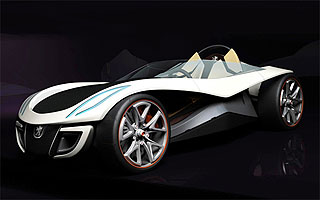
After the Flux car design project was awarded winner of the 4th edition of Peugeot’s Design Contest, the team at Peugeot’s Style Center began creating a full scale model of the winning project, in close relationship with its author, Mihaп Panaоtescu.

In addition, the project is in the process of being crafted virtually for inclusion in “Project Gotham Racing 4,” the racing game developed by Bizarre Creations exclusively for Microsoft®‘s Xbox 360™ video game and entertainment system.

The Flux project won after a selection period, which inspired the creation of 4,029 projects that came from 113 countries. The projects were posted on the website www.peugeot-concours-design.com between September and December 2006.

Beginning in March, the Flux project will be replicated to full scale and presented in Peugeot’s booth for the next Frankfurt Auto show in September 2007. Starting in March is essential since it allows the teams in Peugeot’s Style Center and Microsoft Game Studios to capture the project and have a design that is true to the author’s vision and spirit, in terms of realistic handling and driving sensations.

“Project Gotham Racing 4” is an exclusive Xbox 360 title and will be the latest installment from Bizarre Creations’ beloved racing franchise.

“We are excited to work with Peugeot in helping to visualize the future of Peugeot vehicle design. The Flux is a perfect fit for PGR4,” said Martyn Chudley, Managing Director of Bizarre Creations. “We were impressed with the innovative and the extreme car designs submitted; We hope that Mihai Panaitescu will be excited when he sees The Flux faithfully created on the Xbox 360. We look forward to adding a lot of ‘Gotham’ to its chassis!”

Friday, March 9, 2007

PSA Walks Away From Proton, Chrysler

GENEVA — PSA Peugeot Citroën has withdrawn from negotiations to acquire or form an alliance with troubled Malaysian automaker Proton, which owns Lotus. Further, PSA executives say they are not interested in acquiring the Chrysler Group from DaimlerChrysler, throwing more cold water on speculation that the French carmaker might be planning a return to North America.

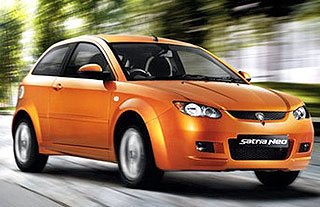
proton satria neoIn a media session at the Geneva auto show, PSA Chief Executive Christian Streiff said the company does not "have time" to look at Chrysler while it is focused on improving profits and quality. "To launch [a bid] now would be such a distraction of effort that it isn't possible," Strieff told reporters. "I do not think we will conclude another industrial alliance."

The company announced Monday that it was breaking off talks with Proton after more than six months of discussions about a possible alliance or acquisition, including a feasibility study on joint production and platform-sharing in Malaysia. An official statement said: "An in-depth study of the automobile market and the economic conditions for co-producing vehicles with Proton concluded that the conditions for the project's success were not present. PSA Peugeot Citroën has informed Proton of its decision not to follow up on the study."

PSA continues to support a number of alliances around the globe, with such automakers as BMW, Dongfeng, Ford, Fiat, Mitsubishi and Toyota.

Proton, meanwhile, continues to discuss the possibility of a tie-up with Volkswagen, but local press reports from Kuala Lumpur say the talks are not going well. VW reportedly wants to control local manufacturing operations, but does not want to take a majority interest in the parent company, which currently is controlled by the Malaysian government.

General Motors also has expressed an interest in Proton, but the nature and status of that interest are unknown.

Monday, February 26, 2007

Peugeot 407 SW Sport XS

An oil-burning estate might seem an unusual target for a sports upgrade, particularly in a range containing a V6 GT Coupe, but Peugeot has given its 407 Station Wagon the body kit treatment.

Peugeot 407 SW sport XSPeugeot 407 SW sport XS 2The Sport XS trim is an option for the 2.2-litre HDi 170 SW, and includes front and rear spoilers, a mesh grill and twin sports exhaust.

Peugeot will also throw in 15-spoke 18-inch alloys and half-leather upholstery.

There's no performance upgrade to match the looks, though, with the Sport XS retaining the standard 170bhp diesel burner.

Prices start at £23,995, a £1,500 hike over the equivalent base model.

Source: topgear

Saturday, February 17, 2007

First Drive: Peugeot 207 CC

When it comes to folding metal roof convertibles, the 207 CC is a winner

Peugeot 207CC

Turbo performance and stowage impress. Dash screen shows roof operation.
It's the car that brought the folding metal roof to the people, kick-starting a trend for affordable drop-tops boasting Mercedes SL-style technology for a quarter of the price.

Looking back, it seems obvious the 206 CC was destined to be a hit. But even Peugeot was surprised by its success. The French firm expected only niche sales, not for it to become the UK's most popular convertible.

So can its replacement, the 207 CC, perform the same trick in a market that is now far more competitive? The arrival of the all-new car hasn't come a moment too soon. Based on the same platform as the 207 hatchback, it sets out to answer the criticisms of its predecessor, with more emphasis on quality. Peugeot predicts even higher sales as a result, but with rivals such as Mitsubishi's Colt CC, Nissan's Micra C+C and Vauxhall's Tigra, competition is fierce.

Изображение “http://www.autoexpress.co.uk/images/front_picture_library_UK/dir_426/car_photo_213101_5.jpg” не может быть показано, так как содержит ошибки.

Emphasising its importance to the Peugeot range, the 207 CC now features a roof which is designed and built in-house. It's totally automatic - there's no need to release any catches - and raises or lowers in 25 seconds, something you can do at speeds of up to 6mph.

The looks have grown up, too. Gone is the fussiness of the 206 CC, with its awkward bootlid slats, and in comes a chunkier, sportier design with a rakish windscreen, chiselled flanks and an athletic look, helped by a neatly clipped tail. Inside, there is plenty of space for those in the front, and a better driving position thanks to a lowered seat and reach/rake adjustable steering wheel. Qual-ity and design have also improved with a soft-feel facia which can be clad in optional leather.

Изображение “http://www.autoexpress.co.uk/images/front_picture_library_UK/dir_426/car_photo_213009_5.jpg” не может быть показано, так как содержит ошибки.
Изображение “http://www.autoexpress.co.uk/images/front_picture_library_UK/dir_426/car_photo_213010_5.jpg” не может быть показано, так как содержит ошибки.
Изображение “http://www.autoexpress.co.uk/images/front_picture_library_UK/dir_426/car_photo_213013_5.jpg” не может быть показано, так как содержит ошибки.

As for luggage room, the rear seats are best used for squashy bags, but the boot is spacious at 449 litres (roof up) and 187 litres (roof down). That makes it arguably more practical than BMW's new 3-Series cabrio.

It's not as well built, though, and some hangovers from the 206 CC remain. The steering column still ro-tates against your foot, the five-speed gearbox feels imprecise and although rigidity has been greatly improved, there's some shake through the windscreen over bumps.

What's more, the roof on our test car failed to close twice when it was parked on a slope. Strengthening of the chassis has also seen the 207 CC put on around 200kg, which has implications for the performance. Of the three 1.6-litre engines available - 120bhp petrol (expected to be the best-seller), 150bhp petrol turbo and 110bhp turbodiesel - we could only test the latter two.

And we'd advise against the oil-burner, which feels strained despite its 240Nm of torque. It's also noisy (roof down) and nose-heavy, with vague steering. The 150bhp petrol is far livelier (0-62mph in 8.6 seconds), more refined and offering purer steering and snappier direction changes.

Both cars ride well, though, and with the hood up, they're quiet and comfortable places to spend time. The kit count is high, too, with base Sport-trimmed models coming with the electric roof, air-con and 16-inch alloy wheels as standard. The GT adds climate control, white dash dials and an MP3-compatible CD stereo.

Prices have risen by around £650 model-for-model, though, and our range-topping test car weighed in at a hefty £17,095. Is the 207 CC still the class leader? Well, it's not perfect, but quality is much improved and it looks great. And for those reasons alone, there's no more desirable CC model on the market.

First opinion:

When it comes to folding metal roof convertibles, Peugeot has a huge following in the UK. And there's no doubt the 207 CC is another winner. It's prettier than its predecessor, has an even more usable hood and a higher quality interior, plus it's surprisingly practical, too. However, some of the build issues that plagued the 206 CC remain, and we're not very impressed by the diesel or the price rises. Even so, it's still destined to go straight to the top of the sales charts.

Price: £17,095
Engine: 1.6-litre HDi GT, 110bhp
0-62mph: 10.9 seconds
Top speed: 119mph
Transmission: Five-speed manual, front-wheel drive
Economy: 54.3mpg
CO2 emissions: 136g/km
Service intervals: 12,000 miles
Standard equipment: Dual-zone climate control, four airbags, 17-inch alloys, leather steering wheel, adaptive headlights, rear parking sensor, tinted rear screen
On sale: Now

source: autoexpress

See also:
Peugeot-sponsored P.L.E.A.S.E design competition
2007 Peugeot Holland & Holland 4007
Peugeot Hits Hard With a Trifecta of World Premieres
Peugeot Design Competition Finalists Highlight Alternative Fuels and Fun
Peugeot 207 CC: priced to open a new world for everyone

Friday, February 16, 2007

Peugeot-sponsored P.L.E.A.S.E design competition

It's one of the most tenuous acronyms we've ever come across, but at least the end result is worth the creaky abbreviation.

Peugeot P.L.E.A.S.E designThe Peugeot-sponsored P.L.E.A.S.E design competition takes it name from the firm's desire to find a car that provides driving 'Pleasure through its Lightness and its Efficiency while remaining Accessible through its Simplicity and Environmentally friendly design'.

We told you it was tenuous.

The winner of this strangely titled contest is the Flux, created by 20-year-old Romanian student Mihai Panaitescu.

Mihai is the youngest ever winner of the competition and his Flux sports car uses a fuel cell in place of a petrol engine.

We hope the contest leads to a job for young Mihai, where he could help Peugeot streamline its acronyms.<,/span>

Tuesday, February 13, 2007

2007 Peugeot Holland & Holland 4007

(from Peugeot Press Release)
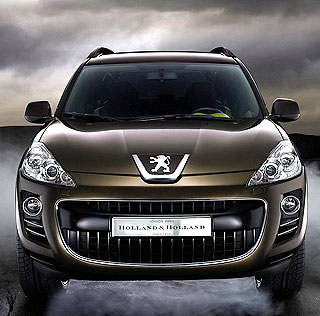
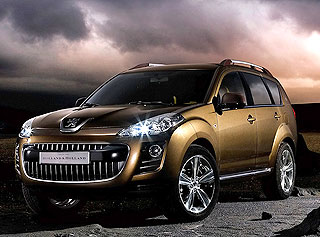
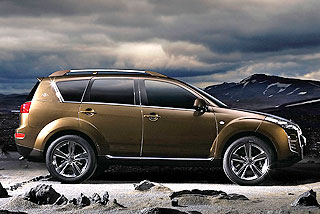
To coincide with the public world premiere of the 4007 at Geneva, Peugeot is unveiling a highly exclusive exercise in style produced in collaboration with luxury manufacturer Holland&Holland, recognised for its spirit of adventure.

2007 Peugeot Holland & Holland 40072007 Peugeot Holland & Holland 4007 2
2007 Peugeot Holland & Holland 4007 32007 Peugeot Holland & Holland 4007 42007 Peugeot Holland & Holland 4007 52007 Peugeot Holland & Holland 4007 6
Exterior

The pearlescent Bronze body colour paintwork combines harmoniously with the vehicle’s
chrome detailing to accentuate the exclusive nature of this 4007 by emphasising its power and
feline qualities combined with the presence of its style and ‘all-terrain’ character.

Water-resistant leather features on the door mirror casings and roof bars, while the “Holland&Holland” logo, the hood of a royal falcon, is applied to the rear quarter panels.

Large 20" alloy wheels, machined from a single block in a unique fourfold design, add presence to the vehicle’s exclusivity.

Interior

Only when you are in the vehicle does the creative alliance between the Peugeot Style Centre and Holland&Holland teams become more apparent. A blend of "Ebony" and "Chartreuse Green" leathers (Holland&Holland colour codes) enhanced by smooth leather edging and original stitching, creates a natural, exclusive and innovative feel. The leather trim covering the passenger compartment is entirely hand-crafted by leather craftsmen from the Peugeot Style Centre. It blends harmoniously with the shape of the fascia panel, the special finish of the seats and the design of the door panels.

The Ebony wool felt floor and its embroidered carpets create a soft and warm environment. Ruthenium styled parts in dark chrome reinforce the exclusivity of the vehicle, particularly around the console and drive mode selector (two-wheel drive, 4x4 or "lock" modes).

At the rear, behind the split tailgate which opens in two sections, a large boot concealing two
retractable seats houses a fantastic luggage compartment specially made by Holland&Holland.

Under the bonnet of this exclusive 4007 lies the 2.2-litre HDi engine developing a power of 115 kW (156 bhp) and a high torque of 380 Nm. A Diesel Particulate Filter System (DPFS) is also included as standard.

Monday, February 12, 2007

Peugeot Hits Hard With a Trifecta of World Premieres

GENEVA — Peugeot announced on Friday that its lineup at the upcoming 77th International Motor Show in Geneva will feature the worldwide debut of three vehicles, including the 207SW Outdoor Concept, a sleek-looking crossover that hints at a future production model.

peugeot 207 gtiThe French automaker released a sketch of the 207SW Outdoor Concept, which features a panoramic glass roof, a split-opening rear hatch, bluish chrome exterior touches, and parachute-type fabric trim in the cabin.

Peugeot and Citroën are treading into SUV territory in Geneva: Citroën with its C-Crosser and Peugeot with the new 4007, a 4x4 all-terrain vehicle. The 4007 was developed in partnership with Mitsubishi and is powered by a new 2.2-liter turbodiesel engine that produces 156 horsepower and 280 pound-feet of torque. The automaker will show a second version of the 4007 by Holland & Holland that features bronze exterior paint, 20-inch alloy wheels and a cabin outfitted with jet black and chartreuse green leather and black chrome.

The Peugeot 207GTi THP 175, a collaboration between PSA Peugeot Citroën and BMW Group, will also make its world premiere in Geneva. The 207GTi features a 1.6-liter THP (turbo high-pressure) gas engine with turbo direct injection. It produces 175 hp and 177 lb-ft of torque.

Monday, February 5, 2007

Peugeot Design Competition Finalists Highlight Alternative Fuels and Fun

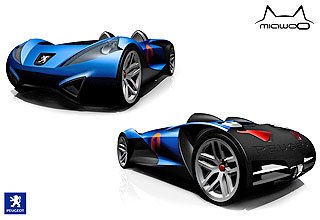
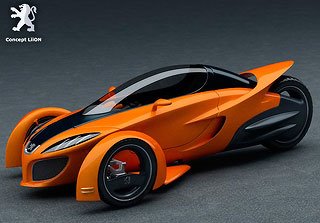
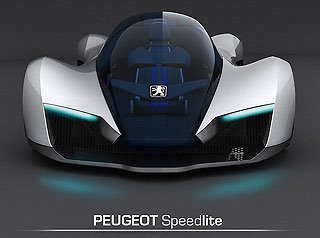
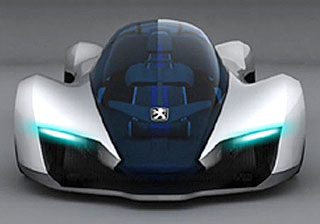
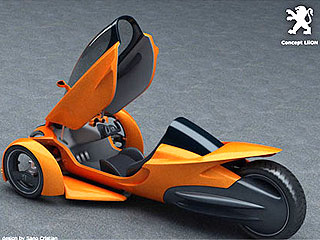
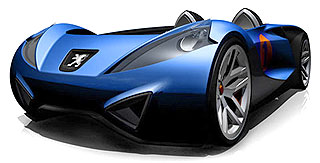
PARIS — The 10 finalists in Peugeot's annual design competition include the Concept LiiON, a three-wheeler powered by lithium-ion cells with a rear end that resembles a lion's tail, and the Speedlite, a high-performance hybrid with a Wifi-driven driver console.

The finalists are a global group from around the world including Brazil, China and the United States. As a group, they tended to favor hybrids and other alternative powertrains, often with an emphasis on "extreme power."

Inspiration was drawn from old Formula 1 cars, as well as open-wheel hot rods of the 1950s.

Peugeot said more than 4,000 cars from 113 countries were entered into the 2007 competition, the most since the event started four years ago. Part of the selection phase included a vote by Internet users to help determine the 10 finalists. The winner will be named at the Geneva Motor Show in March. A full-scale model of the winner will be presented at the Frankfurt Motor Show in the fall, and the car will be replicated in an upcoming Xbox 360 game, Peugeot said.

Finalists include the Speedlite, a creation of Turin design students

peugeot design concept speedliteNemanja Lalcic and Mateo Krzanowsky. The glass-and-carbon-fiber hybrid has a maximum speed above 186 mph and goes from zero to 62 mph in under 5 seconds.

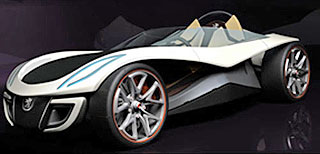
The Peugeot Flux was designed by Italian Mihai Panaitescu,

peugeot design concept fluxwho said the open-air concept runs on hydrogen and has an integrated Xbox 360.

The Allscape concept by Venezuelan Gustavo Ferrero is outfitted with a natural gas-powered 2.0-liter twin-turbo V4 mated to a seven-speed gearbox. Ferrero said the emphasis is on "extreme power." The concept has an ultralight aluminum-and-carbon-fiber frame, as well as an anti-noise sound system and a "geographical console" with a compass, altimeter and artificial horizon.

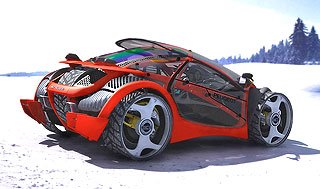
Dario Gagula's Peugeot e-motion is an electric sports car that combines concave and convex surfaces. The orange and silver Peugeot 910 has a transparent roof and an elaborate security system, including doors with no keyholes.

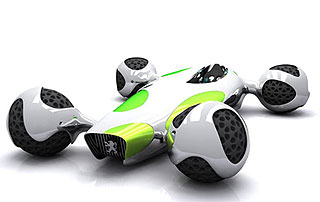
The one-seater Peugeot N Joy by Wesley Saikawa of Brazil
peugeot design concept njoy was inspired by old Formula 1 cars and is "omnidirectional." Saikawa says its sphere can roll in any direction, and the car can turn 360 degrees around itself.

Peugeot Concept LiiON by Christian Sano of Romania

peugeot design concept liion is a three-wheeler with a system that allows the driver to choose between "Sunday cruise driving" mode and "daredevil" mode.

Other finalists include the Peugeot Cub by Ka Dan of China and the MiawoO roadster by Noumid Bendifallah of France.

peugeot design concept miawoo
The sole U.S. finalist is the hybrid Peugeot Plaire by James Ma.

peugeot design concept plaire It was inspired by the open-wheel hot rods of the 1950s combined with sporty roadsters of today. The open-cockpit Plaire uses recycled materials.

Tuesday, January 30, 2007

Peugeot 207 CC: priced to open a new world for everyone

It was in the 1930s that Peugeot started the innovative concept of the coupé cabriolet, with the 601, 401 and 402 “Eclipse”. This concept was to become one of Peugeot’s trademark features and make the marque the No1 producer of coupé cabriolets, with today more than 500,000 vehicles sold worldwide.

The car that changed the UK convertible car market forever was the Peugeot 206 CC. Launched in the UK in January 2001, the 206 CC broke new ground with regards to technology, manufacturing and entry price.

It brought a coupé cabriolet with an electric folding roof into the price range of everyone, not justthe preserve of the luxury car market segment. Its introduction saw it transform the UK market for convertible cars and become the best-selling convertible car in the UK for three consecutive years. Its success, however, is worldwide and with more than 360,000 units produced it is the world’s best selling small coupé cabriolet.

With the launch of the Peugeot 207 CC in March 2007, it will replace the legendary Peugeot 206 CC.

The Peugeot 207 CC will be available at launch with two petrol engines and one diesel engine combined with two trim levels – Sport and GT. Both of the petrol engines have been developed as part of the co-operation between PSA Peugeot Citroën and the BMW Group and introduce technology not normally found in this market segment.

The first engine, and the one which is expected to be the most popular choice, is the 1.6 litre 120 bhp petrol engine. This engine has greater performance across the range than the previous 1.6 litre petrol engine fitted to the 206 CC and with a combined drive cycle fuel consumption figure of 43.5 mpg, reduces fuel consumption and emissions by 8% and 7% respectively.

The second petrol engine is the class leading 1.6 litre 150 bhp THP petrol turbo-charged engine first seen in the 207 GT THP 150 hatchback. This engine offers incredible engine flexibility due to its maximum torque of 180 lb ft available from an engine speed of only 1400 rpm and its maximum power of 150 bhp at 5800 rpm. The use of an innovative Twin-Scroll turbocharger, variable inlet valve timing and direct high-pressure fuel injection creates an engine with a remarkable balance between performance and low fuel consumption / emissions.

The final engine is Peugeot’s class leading 1.6 litre HDi diesel engine producing 110 bhp which is also fitted with a diesel particulate emission filter (DPFS) so ensures excellent performance and low fuel consumption with emissions of only 136 g/km.

The 1.6 litre 120 bhp petrol engine is available with either a five-speed manual gearbox or a four-speed automatic gearbox with “Porsche Tiptronic” sequential manual selection as well.

The new electric folding roof for the Peugeot 207 CC has been designed 100% in-house and is the result of Peugeot’s expertise in the design and manufacture of coupé cabriolets. It has been designed against a rigorous specification in terms of quality and operating durability.

With a similar operation to the 206 CC, the 207 CC roof, however, differs significantly in terms of convenience thanks to its entirely automatic operation – no more manual release handles. The only manual operation consists of pressing the control button for 25 seconds, during which time the opening or closing cycle is completed; after all four windows have been lowered automatically.

Class Leading Safety

The 207 CC offers its occupants a level of passive safety that is as comprehensive as possible. To limit injury as a result of a front or side impact, the structure of the Peugeot 207 CC has been specially strengthened to compensate for the absence of a “roof” superstructure.

To protect occupants when the 207 CC is in the cabriolet configuration an active roll-over protection system is a standard feature on all 207 CC models.

Five airbags, three of which have been designed specially for the 207 CC, are fitted as standard on all models to provide further protection for the occupants:

- Two adaptive front airbags;

- Two “head-chest” side airbags located in the side of the front seats;

- A steering column airbag designed to protect the driver’s lower limbs.

For child safety, the front passenger Seat of the 207 CC is equipped with a 3-point Isofix mounting system and the passenger airbag can be switched off, when a rear facing child Seat is used.

As a true 2+2, the 207 CC also offers two rear seats, a feature which genuinely distinguishes it from a strict two seater.

The 207 CC is therefore able to appeal to young couples with a child, avoiding the need for multiple cars, by offering the possibility of carrying one or even two people in the back for a short journey. The space created by the rear seats can also be used for hand luggage and coats, or to keep fragile items such as a bouquet of flowers in easy reach.

Larger than the outgoing 206 CC and with standard safety equipment normally only found on vehicles in a much more expensive market segment the 207 CC, like its predecessor, will once again write a new chapter in the history of small coupé cabriolets.

Manufacturer’s Recommended Retail Prices

Model

CO2 g/km

On-the-road MRRP

Ins Group

Sport 1.6 16v 120

155

£14,795.00

8E

Sport 1.6 16v 120 Automatic

173

£15,795.00

8E

Sport HDi 110

136

£15,895.00

8E

GT 1.6 16v 120

155

£15,995.00

9E

GT 1.6 16v 120 Automatic

173

£16,995.00

9E

GT THP 150

171

£16,895.00

12E

GT HDi 110

136

£17,095.00

9E

Standard equipment on all models includes alloy wheels (16” or 17” depending on model), sports front seats, front fog lights, air conditioning (manual on Sport models, dual zone climate control with air conditioning on GT models), electrically operated / heated door mirrors, trip computer, sports front exterior styling, ESP (GT models, optional on Sport models), ABS with EBFD and EBA, body coloured door mirrors and handles, driver and passenger Seat height adjustment, steering

column adjustable for reach and rake, two active rear roll over protection bars, electric windows, remote control central locking with deadlocks, steering column airbag, side airbags, driver and passenger airbags, electric power steering…

A comprehensive range of options will be available for the 207 CC at launch.

Monday, January 22, 2007

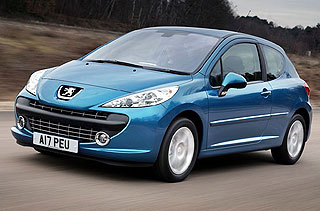
Peugeot 207 Turbo and 107 XS

Peugeot is getting on with what it does best by building sporty little hatches, and it's just announced not one but two of the critters.

Hot on the heels of the 150bhp 207 Turbo, the 207 Sport uses a 120bhp version of the same 1.6-litre engine.

Peugeot 207 TurboIt's a clever engine with variable valve timing, but the important stuff is that it does 0-62mph in 10.7 seconds and has a top speed of 125mph.

Those are not the most scintillating warm hatch figures and the new automatic gearbox takes the edge off further.
This Tiptronic auto 'box means 0-62mph in 12.7 seconds and a 122mph top speed.
Prices for the auto start at ££12,795, while the manual gearbox model costs £11,795.

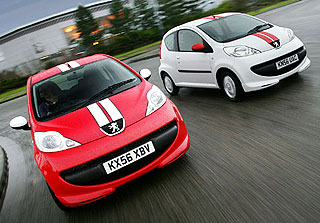
The second new sporty hatch for Peugeot is the 107 XS, reviving a badge that has previously been attached to the fine handling 106 and 205 XS models.

Peugeot 107 XS
The obvious differences between a standard 107 and the XS are the bold stripes down the centre of the car and the door mirrors painted in contrasting colours.

There's also a sports twin exhaust, revised front and rear bumpers, and 14-inch alloy wheels.

No extra power for the 68bhp 1.0-litre engine, but with extra grip the 107 XS should be good fun to drive.

The price for the 107 XS is £8,345 and it's on sale now.

source: topgear

Friday, January 19, 2007

Peugeot 207 Sport state of the art 1.6 litre 120 bhp petrol engine

Peugeot introduces two new petrol models into its successful 207 range, the 207 SPORT 1.6 16v 120 and the 207 SE 1.6 16v 120.

Both models will be powered by a new 1.6 litre 16v petrol engine designed in co-operation with the BMW Group and manufactured for both parties at PSA Peugeot Citroën’s Douvrin manufacturing plant.

Already seen in the BMW Group’s Mini Cooper, this engine will replace the current Peugeot 1.6 litre 16v 110 bhp engine in the 207 range.

EP6 – 1.6 LITRE 16V PETROL ENGINE

Following on from the 1.6 litre 16v THP 150 turbo-charged (EP6DT) engine, the EP6 is the second engine created from the co-operation with the BMW Group. It has maximum power of 120 bhp at 6000 rpm and maximum torque of 120 lb ft at 4250 rpm. One of its strengths, however, is its very flat torque curve which, even at only 2000 rpm results in 103 lb ft, or 88% of its maximum torque being produced, giving excellent driveability.

This engine also sees the introduction of technology which is a genuine first for a vehicle in the B segment. In addition to a variable valve timing system for both the inlet and exhaust camshafts, there is also a variable valve lift system on the inlet valves allowing the maximum valve lift to be adjusted gradually according to the position of the accelerator pedal. The use of this technology removes the need for a throttle butterfly as the engine power is now controlled through the infinite adjustment of the inlet valve lift and intake valve opening times.

In a conventional engine the engine power output is controlled by means of a throttle butterfly. The required amount of air to be drawn into the engine is regulated by the position of the throttle butterfly; however, at certain engine speeds and throttle butterfly positions, the incoming air has to “squeeze past” the partially closed or closed butterfly, reducing the air flow into the engine. The overcoming of this “resistance” results in both a reduction in potential power and also reduces overall engine efficiency but, more importantly, an unnecessary increase in fuel consumption.

The combination therefore of the variable valve timing (VVT) system and the variable inlet valve lift system improves both the engine’s efficiency and significantly reduces fuel consumption and, therefore, CO2 emissions. It also guarantees improved engine responsiveness and greater engine flexibility.

The introduction of this new engine will also see the first Peugeot 207 automatic models introduced in SPORT and SE trim levels.

THE “PORSCHE TIPTRONIC SYSTEM” AUTOMATIC GEARBOX

Available for the first time in the Peugeot 207 hatchback range, a “Porsche Tiptronic System” automatic gearbox is now available with the introduction of the new
1.6 litre, 16v 120 bhp petrol engine. This electronically controlled “automatic auto-adaptive” gearbox has four speeds and an electronic control of the gearshift functions. The driver can also select either “sport” or “snow” operating modes. Ability for the gearbox to “lock-up” is present on all gears reducing internal friction and, therefore, reducing drag. The use of this system also reduces fuel consumption which remains quite close to that obtained with a manual gearbox.

“PORSCHE TIPTRONIC SYSTEM” SEQUENTIAL CONTROL

Here, the innovation resides in the gear shift control which acquires a dual function: on the right-hand side, a gate with a PRND pattern and, on the left-hand side, accessible from the “Drive” position, a “Porsche Tiptronic System” with sequential control, offering the driver the possibility of “active” driving. In this position, by pushing the gearlever forwards or backwards it is possible to go “up” or “down” the gears. The system reverts automatically to first gear when the car comes to a standstill. Conversely, as the engine speed increases, it switches automatically to a higher gear before the maximum permitted engine speed is reached, in order to protect engine components.

The engine’s greater power output and increased torque gives significant improvements in driveability. The biggest gains, however, are the reduction in fuel consumption of 15% in the combined cycle and CO2 reduced to only 145 g/km with a manual gearbox.

The New Peugeot 207 1.6 litre SPORT and SE models go on sale in the UK in March 2007, priced from only £11,795 on-the-road.

source: duemotori

Peugeot Sport XS for 107

Peugeot’s popular 107 range entry-model is, from February, to be available in a new 3-door ‘Sport XS’ trim level for young-minded individuals who like a more racy and personalised vehicle. Available from just £8,345, the 107 Sport XS is a combination of distinctive appearance with great value, and is available in four colour combinations.

Customers can choose between Diamond White (with red stripes and silver edges), Laser Red (with white stripes and black edges), Raven Black metallic (with red stripes and silver edges) or Zircon Grey metallic (with graphite stripes and white edges).

Key specification features (over the well-specified Urban model) include: 14” ‘Magna’ 6-spoke alloy wheels with locking wheel nuts, a rev counter, front bumper spoilers, twin racing stripes, door mirror housings to match the stripes and a twin sports exhaust system. On the inside there’s a leather trimmed steering wheel with red stitching, a red sports gearknob plus leather gaiter with red stitching and a red finish to the centre console and air vent surrounds.