Showing posts with label Land Rover. Show all posts

Tuesday, January 15, 2008

Land Rover LRX Hybrid Concept Unveiled at 2008 NAIAS

Land Rover unveiled a vision of its future today at the North American International Auto Show (Detroit Auto Show and/or NAIAS) with the world debut of the LRX hybrid concept. The Land Rover LRX is a bold evolution of Land Rover design that indicates the brand's progressive shift into new areas of the market, while remaining true to its core values.

Land Rover LRX Hybrid Concept

Land Rover LRX Hybrid Concept

As the company prepares to celebrate its 60th anniversary during 2008, the three-door LRX, with its more compact size, lighter weight and sustainability-focused technologies, clearly addresses the needs of a changing world and offers the potential of 120 g/km CO2 emissions.

Land Rover LRX is a cross-coupe and dramatically extends the scope of what Land Rover represents. The first all-new Land Rover revealed since Gerry McGovern became the company's design director, LRX is a natural extension of the Land Rover range, complementing the existing models and helping to define a new segment.

"The LRX concept delivers the powerful message that we are as serious about sustainability as we are confident about the continuing relevance and desirability of our vehicles," says Phil Popham, Land Rover's managing director. "LRX is in every respect a Land Rover, but it's a very different Land Rover. At this stage, LRX is purely a concept, designed to help us develop our thinking as well as gauge customer reaction -- but this feels like a hugely exciting direction to take."

LRX is conceived as being powered by a 2.0-liter, turbodiesel engine, capable of running on bio-diesel. In combination with other Land Rover technologies, this powertrain could reduce fuel consumption by as much as 30 percent compared with other SUVs of comparable size, as well as reduce emissions.

The concept's integrated Electric Rear Axle Drive (ERAD) would allow LRX to use electric drive alone at lower speeds while retaining full (even improved) sport utility ability in tough conditions. Unlike the hybrid technology used by some SUV rivals, Land Rover's unique solution retains mechanical drive to all four wheels.

Off-road, the ERAD would provide additional torque only when it is needed, and with maximum electrical torque from standstill, this solution offers even better low-speed control and enhanced pull-away on difficult surfaces. On the road, the ERAD would allow low-speed traffic creep up to 20 mph on electric power alone, with the Integrated Starter-Generator (ISG) function re-starting the engine automatically when needed. The electric drive would then continue to assist the mechanical drive until the engine is running in its most efficient range. The ISG would also stop the engine automatically when the vehicle halts in traffic, so the engine does not idle needlessly, and restart it quickly and smoothly as required.

LRX also incorporates Hill Descent Control and Land Rover's acclaimed and user-friendly Terrain Response system. In the LRX, Terrain Response adds a special "Eco" mode, for optimal economy, to the standard modes found on all other Land Rover vehicles.

The design of LRX was developed entirely in-house by Design Director Gerry McGovern's team, driven by a passion to create a vehicle that truly represents Land Rover's future thinking. Inside, LRX's distinctive seats 'float' on individual plinths and have open frameworks to reinforce the impression of light, airy interior space -- while also creating useful under-seat and under-floor stowage areas. To reduce overall vehicle weight, the glass for the side windows and roof were replaced with polycarbonate from SABIC Innovative Plastics, which is around 40 percent lighter, yet still strong and scratch-resistant.

Even the choice of premium-quality trim materials reflects Land Rover's deep thinking about sustainability, with vegetable-tanned leather (chromium-free, so better for recycling), extensive use of aluminum (both lightweight and readily recyclable) and carpeting made of felt from sustainable sources. And the luxurious, vanilla-colored 'fine suede' on the door inserts and headliner is a 100% recycled material made from used plastic bottles and fibers.

"We are determined to make sustainability a key element in our future product design and the way we do business, while still creating vehicles that have a strong emotional appeal as well as fulfilling people's practical needs," adds Phil Popham. "No single technology delivers all the answers to whole-life sustainability, but the LRX concept brings together some of the ideas for the future that interest us, integrating them into a car that we believe represents an exciting way forward for Land Rover."

Sunday, December 16, 2007

NAIAS: Land Rover LRX concept

NAIAS: Land Rover LRX concept

Land Rover unveils a vision of its future at the NAIAS (Detroit Show) in January 2008, with the world debut of the LRX concept - a bold evolution of Land Rover design that indicates the brand’s progressive shift into new areas of the market, while remaining true to its core values. As the company prepares to celebrate its 60th anniversary during 2008, the three-door LRX, with its more compact size, lighter weight and sustainability focussed technologies, clearly addresses the needs of a changing world.

"The LRX concept delivers the powerful message that we are as serious about sustainability as we are confident about the continuing relevance and desirability of our vehicles," says Phil Popham, Land Rover's managing director. "The LRX is in every respect a Land Rover, but it's a very different Land Rover.

"LRX has unmistakable Land Rover design and the breadth of capability that you'd expect from our vehicles. But it carries those essentials into a segment where the
brand has never been before, and with a proposed level of efficiency that would make it one of the cleanest vehicles in its class. It is Land Rover’s way of affirming the brand’s responsible approach to future product development. At this stage, LRX is purely a concept, designed to help us develop our thinking as well as gauge customer reaction – but this feels like a hugely exciting direction to take."

Compact and premium
The LRX is described as a cross-coupĂ©, and dramatically extends the scope of what Land Rover stands for. Though smaller than Freelander 2 / LR2, the LRX is conceived as a premium car, designed to appeal to new customers in the luxury and executive sector – those who want many of the benefits of a 4x4 and the visual presence of a larger vehicle, but in a more compact package.

The first all-new Land Rover revealed since Gerry McGovern became the company's design director, LRX is a natural extension of the Land Rover range, complementing the existing models with a car that will help to define a new segment. Its many recognisable Land Rover design cues include bold new interpretations of the signature clamshell bonnet, the floating roof and the solid ‘wheel-at-each-corner’ stance.

"LRX is a design born out of passion for the brand, but it is different, relevant, engaging and exciting – because Land Rover has never built ordinary cars," says Gerry McGovern. "LRX has a highly desirable identity and the design alludes strongly to its capability, while clearly underlining our forward-looking philosophy – it's a Land Rover that would be comfortable on Bond Street or Fifth Avenue, but wouldn’t flinch at getting its wheels dirty."

Its compact size is one of its greatest assets, which will appeal to anyone who wants the versatile ability of an agile 4x4 with the cachet of the Land Rover name. In addition, its lower weight and the reduced aerodynamic drag resulting from the smaller frontal area give significant gains in fuel efficiency and reduced CO2 emissions.

The LRX concept also adopts intelligent power management systems and other technologies first shown by Land Rover in the Land_e concept in 2006. Further details of the LRX's powertrain and sustainability technologies will be released at the Detroit Show.

Extending 'breadth of capability'
The positioning of LRX could be described as moving subtly from traditional SUV to crossover, with its more car-like appearance and dynamics that are sportier and on-road biased. But while its character is underlined by excellent agility, handling and performance, the LRX also promises the widest breadth of capability in the class. To help achieve this, it has full-time four-wheel drive and Hill Descent Control, as well as a special version of Land Rover’s acclaimed Terrain Response system, to optimise traction on difficult surfaces ranging from icy roads to wet grass, gravel and snow. But to reflect LRX's more on-road bias, Terrain Response also gains a new ‘Eco’ mode for lower emission urban driving.

The design of the LRX was developed entirely in-house, driven by a passion to create a car that truly represents Land Rover’s future thinking. It has a very dynamic profile, with a distinctive taper to the floating roofline and a muscular shoulder running the length of the car, accentuated by the rising beltline. The glazing wraps right around the LRX, with no exposed pillars, creating a bold design graphic. The architectural structure of the upper body can be glimpsed through the windows and roof – echoing some of the best contemporary buildings.

Pushing the wheels out to the four corners helps give the car its purposeful stance, and its front-end design makes a powerful and instantly recognisable statement of Land Rover’s identity. There are new interpretations of Land Rover’s traditional clamshell bonnet, distinctive headlamps, jewel-like, tapering blade indicator clusters front and rear, and subtle side vents. The LRX’s wheel arches are wide but softly integrated, housing 20-inch alloy wheels.

The carefully sculpted corners dramatically reduce the car’s visual overhangs front and rear. With its perforated two-bar grille, door releases concealed in the car’s shoulders, and graphic details ‘punched out’ of the smooth body surfaces rather than overlaid on them, the LRX is beautifully proportioned and elegantly simple – but very dramatic and distinctive.

Impeccable, premium interior
The interior of the LRX concept clearly demonstrates how a compact Land Rover can still be roomy, practical and versatile – and one with great sophistication. The impeccably executed cabin features a combination of soft leathers in rich tan and dark chocolate, with polished aluminium details.

The ‘fast’ sloping architecture of the centre console reflects the LRX’s sporty dynamics, as does the distinctive binnacle over the instrument cluster. The electronic display uses ‘floating’ LCD graphics to create a three-dimensional look that can be personalised for different drivers, as well as interacting with the LRX’s touch-screen display.

The instrument graphics present data in layers depending on their level of importance, to give maximum relevant information with minimum distraction. When appropriate, displayed information transfers between the main instrument cluster and the touch screen. And further adding to the LRX’s involving personality, the different drivetrain modes are matched by changes in the cabin’s background lighting colour – green in economy, red in sports and blue in standard mode.

Clever use of space
Although the LRX is compact, clever use of space makes it impressively roomy, and many neat design touches maximise its practicality. A second touch screen area gives a fully interactive display and control for the LRX’s iPhone docking facility. On either side of the horizontally-split, power-operated tailgate, removable and power-adjustable speakers include an iPod docking station. There is also a coolbox, plus a bottle chiller that can be clipped to the lowered tailgate. This also has integral aluminium cupholders between two padded seating areas, for a new twist on the idea of a traditional Land Rover tailgate lunch.

Every interior design detail combines to maximise both actual space and the feeling of space. The clear roof is supported by a ‘spider’ frame running into the A-pillars, and the rear quarter pillars have glazed apertures for improved visibility and a lighter feel in the cabin.

The LRX’s distinctive seats ‘float’ on individual plinths and have open frameworks to reinforce the impression of light, airy interior space – while also creating useful under-seat and under-floor stowage areas. The clever, powered mechanism of the Seat backs maximises interior flexibility and helps create a large, flat storage area when needed, complete with multiple tie-down options. The generous load space and through-loading option also help accommodate bikes, skis or surfboards.

"Flexible load carrying capacity is fundamental to the concept of the LRX," says Gerry McGovern. "With this car, we've interpreted the idea of Land Rover 'breadth of capability' to be more about versatility than about ultimate off-roading. This meets the needs of the new customers that we believe would be attracted by this type of car. They will not only appreciate LRX's versatility, but will also recognise that this has been packaged with the highest levels of precision."

Sustainable product design
The structures of the seats and instrument panel are elegant enough to be left exposed - one novel approach that Land Rover's designers have taken to reduce vehicle weight. Another example is replacing the glass for side windows and roof with polycarbonate, which is around 40% lighter.

Even the choice of the premium quality trim materials reflects Land Rover's deep thinking about sustainability, with vegetable-tanned leather (chromium-free, so better for recycling), extensive use of aluminium (both lightweight and readily recyclable), and carpeting made of felt from sustainable sources. And the luxurious vanilla-coloured 'fine suede' on the door inserts and headliner is a 100% recycled material made from used plastic bottles.

"We are determined to make sustainability a key element in our future product design and the way we do business, while still creating vehicles that have a strong emotional appeal as well as fulfilling people's practical needs," says Phil Popham.

"No one technology delivers all the answers to whole life sustainability, but the LRX concept brings together some of the future ideas that interest us, into a car that we believe represents an exciting way forward for Land Rover."

Friday, December 14, 2007

Land Rover LRX Concept first official images

Today Auto Motor und Sport published the first official images of the Land Rover LRX Concept that will be shown for the first time at the 2008 NAIAS in Detroit.

The LRX is a two-door crossover with a coupè-like body that previews the future small Land Rover, which will be positioned under the Freelander. The production version is expected to make its debut in spring 2009.

Land Rover LRX Concept Land Rover LRX Concept -2Land Rover LRX Concept -3The car measures 435 cm in length and 155 in height, being shorter but, above all, quite a bit lower than the Freelander. The concept has aggressive air intakes, 20" rims and narrow head lights. In the side view there is a notably high belt line which creates along with the sloping roof profile a small glass surface, similar to a sports car one.

The panoramic roof shows the futuristic interior, covered in two-tone leather and highlighted with polished aluminium trim. There are only four seats as the central tunnel is extended to the rear.

The LRX is based on the Ford Focus platform and has a hybrid drive with the electric engine positioned on the rear axle.

© Source: eurocarblog

Friday, March 30, 2007

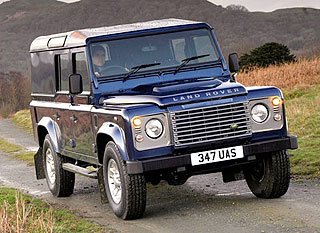
2007 Land Rover Defender

GAYDON, England — Land Rover has updated its long-lived Defender for its 60th birthday, but there are still no plans to bring the iconic off-roader back to the U.S. market.

2007 Land Rover DefenderThe 2007 Defender, which gets numerous enhancements inside and out, goes on sale in mid-April in the U.K., priced from $36,667 for the basic Defender 90 pickup. The range-topping Defender 130 will reach British dealers in July, priced from $44,475.

Among the highlights for 2007 are a new 2.4-liter common-rail diesel engine, a six-speed gearbox, a fully integrated front fascia, new seating and improved heating and air-conditioning.

Land Rover says it still sells 6,000 Defenders a year in Britain, its largest market. U.K. dealers already have taken 800 orders for the new model, which can be ordered in one of 14 different body styles, including pickup, soft top, crew cab and station wagon.

source: insideline

Tuesday, March 6, 2007

Land Rover Defender

It's new, but it's not, if you see what we mean.

This is the Land Rover Defender, which will be launched on the world stage at Geneva tomorrow.

Land Rover DefenderFrom the outside, it looks much like the previous model, although if you get your magnifying glass out, you'll spot a power bulge on the bonnet.

This is one clue: it's the engine.

It's an all-new 2.4-litre common-rail turbodiesel attached to a six-speed manual gearbox, and will keep the current Defender on the Land Rover sales brochure until at least 2010.

Inside the revised vehicle, there's also a new dash design and, that wonder of modern technology, air conditioning to keep the Collie dogs in the back nice and snug.

Saturday, February 3, 2007

Environmentalists oversee Land Rover CO2 offset programme

Leading international environmental figures from government, business and education have signed up to oversee Land Rover's industry leading carbon dioxide offset programme.

An independent Board of Governance, specially formed for this purpose, will include, among others, one of the first people to raise awareness of climate change, the former government adviser and diplomat, Sir Crispin Tickell. He'll be joined by the director of the Environmental
Change Institute at Oxford, Professor Diana Liverman, the director of the Business Programme at the sustainable development charity, Forum For The Future, Dr Sally Uren, and the government adviser and former director of environment policy at B&Q, Alan Knight. Further appointments will be announced in due course.

Land Rover has cut emissions with each successive model in its range and is developing technologies to make further improvements. The CO2 emissions from its main manufacturing plant at Solihull have been cut by 30% over the past 10 years. The offset programme is a key part of an integrated approach to further reducing CO2 emissions and will offset all of the CO2 generated by Land Rover’s manufacturing operations and the first 45,000 miles of vehicle use by its UK customers. It is run by Climate Care, a highly respected offset provider. The ultimate goal is CO2 neutrality with investments being made in renewable energy projects such as wind and solar, technology change and energy efficiency.

Sir Crispin said, “Climate change is a long standing issue and these are important steps towards practical actions to tackle part of that problem.”

Sally Uren said, “Offset schemes are a useful way of engaging the public on the climate change agenda. However, offsetting is a transition mechanism at best, as it will be investment in new technologies that will provide the long-term solutions to climate change. Land Rover recognises this and we look forward to seeing new advances in technology reach the market in the not too distant future.”

Phil Popham, Land Rover’s Managing Director, said, “The Land Rover carbon offset programme is an industry leading initiative and demonstrates our commitment to the environment, which includes investing in new technologies to further reduce the emissions from our vehicles. I am delighted that such distinguished figures, who’ve played leading roles in highlighting the issue of climate change, have agreed to give us their advice and assistance in tackling this issue.”

The board will meet every four months and will use its expertise to ensure due diligence is exercised throughout the offset process to make certain it is accountable, efficient and transparent.

Sunday, January 21, 2007

Double Win For Land Rover At The 2007 What Car? Car

Land Rover Discovery 3

What Car? group editor, Steve Fowler, said: “Land Rover really has got the 4x4 market sewn up. The new Freelander brings new levels of ability, comfort, refinement and cool to the compact 4x4 segment, just as the Discovery has done in the large 4x4 market. Both are worthy What Car? Award winners.”

Land Rover’s managing director, Phil Popham, said: “We are absolutely delighted to win these prestigious awards from What Car? for both the Freelander 2 and the Discovery 3, off the back of our second successive record sales year.”

Popham continued: “The Freelander 2 is our most fuel-efficient model to date and has been launched to widespread acclaim from both the media and customers - who now offset the carbon dioxide for the first 45,000 miles’ use through our industry leading programme with Climate Care. This award is recognition of Freelander 2’s outstanding breadth of capability and gives us a good start as we look forward to the year ahead.

“Achieving the Best Large 4x4 award for three consecutive years for the
Discovery 3 TDV6 is a testament to its class-leading diesel engine, its versatility and its all-round package.”

The Freelander 2 is on-sale now at Land Rover dealerships throughout the UK, priced from £20,935 to £33,990, including the contribution to offset carbon dioxide emissions. It has already sold nearly 1,500 units in the UK, since going on sale in December.

The biggest selling model in the UK and in Europe is expected to be the TD4 manual with a combined fuel economy figure of 37.7mpg and CO2 emissions of 194g/km.

The Discovery 3 has sold nearly 30,000 units in the UK and 115,000 units globally since launch in 2004, and continues to collect critical accolades the world over with 94 international awards to date.

source: carpages